 Back
BackPrice Controls and Market Efficiency: Microeconomics Study Notes
Study Guide - Smart Notes
 Tailored notes based on your materials, expanded with key definitions, examples, and context.
Price Controls and Market Efficiency
Government-Controlled Prices
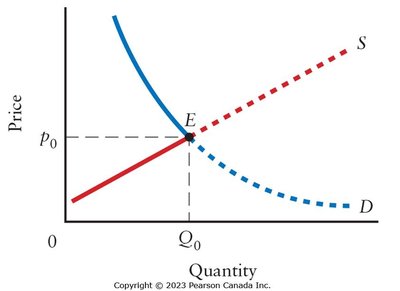
Government intervention in markets often takes the form of price controls, which can lead to disequilibrium. Disequilibrium occurs when the quantity demanded does not equal the quantity supplied, resulting in either excess supply or excess demand. The actual quantity exchanged in the market is determined by the lesser of the quantity demanded or supplied.
Disequilibrium Price: The price at which the market does not clear, causing either a surplus or shortage.
Voluntary Transactions: Require both a willing buyer and seller; the lesser of demand or supply determines the quantity exchanged.
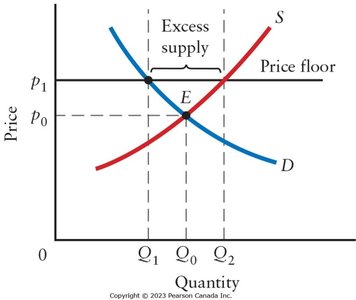
Excess Supply: Occurs when price is above equilibrium.
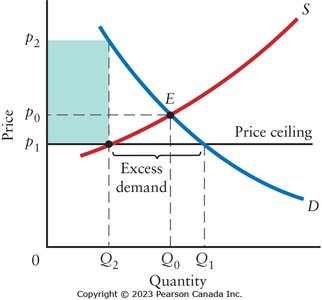
Excess Demand: Occurs when price is below equilibrium.
Price Floors
A price floor is the minimum permissible price for a good or service, set by the government. If the price floor is above the equilibrium price, it is binding and results in excess supply.
Binding Price Floor: Leads to excess supply, as quantity supplied exceeds quantity demanded.
Minimum Wage: An example of a price floor in the labour market. A binding minimum wage reduces employment and increases unemployment.
Effects: Some workers benefit from higher wages, while others lose their jobs. Firms are worse off due to higher wage costs.
Price Ceilings
A price ceiling is the maximum price allowed for a good or service. If set below the equilibrium price, it is binding and results in excess demand.
Binding Price Ceiling: Leads to shortages, as quantity demanded exceeds quantity supplied.
Allocation Methods: May include first-come, first-served, waiting in lines, or hidden markets (black markets).
Goals: Restrict production, keep prices down, and promote equity during shortages.
Hidden Markets: Arise when products are sold illegally above the controlled price.
Rent Controls: A Case Study of Price Ceilings
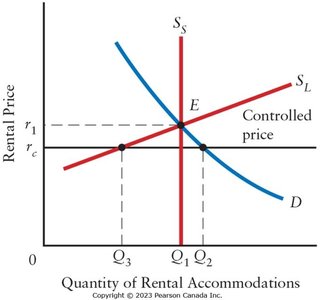
Rent controls are a specific form of price ceiling applied to rental housing. They are intended to make housing more affordable but often lead to shortages and inefficiencies.
Short-Run Effects: Quantity supplied remains fixed, leading to a shortage.
Long-Run Effects: Supply decreases further, worsening the shortage.
Alternative Allocation: Includes non-price methods and hidden markets.
Ontario Case: Rent controls led to shortages, policy changes, and exemptions for new units.
Winners: Existing tenants benefit from lower rents.
Losers: Landlords and future tenants suffer from reduced returns and housing availability.
Policy Alternatives: Government can subsidize housing or provide income assistance, but these have resource costs.
An Introduction to Market Efficiency
Economic Surplus and Market Efficiency
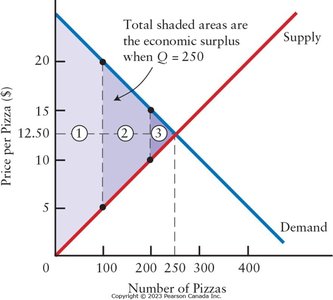
Market efficiency is assessed by the concept of economic surplus, which is the sum of consumer and producer surplus. The free-market equilibrium maximizes total economic surplus.
Consumer Surplus: The difference between what consumers are willing to pay and what they actually pay.
Producer Surplus: The difference between the price received by producers and their costs.
Total Economic Surplus: Maximized at equilibrium; area between demand and supply curves.
Demand as Value and Supply as Cost
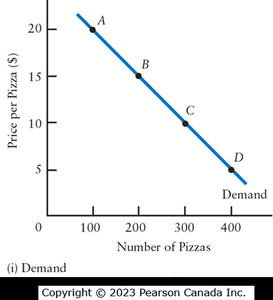
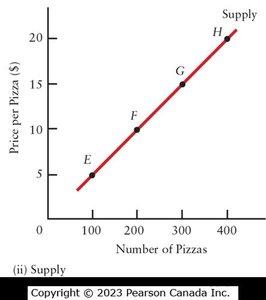
The demand curve represents the value consumers place on each unit, while the supply curve represents the cost to producers for each unit.
Demand Curve: Shows the maximum price consumers are willing to pay for each unit.
Supply Curve: Shows the minimum price producers are willing to accept for each unit.
Market Inefficiency with Price Controls and Output Quotas
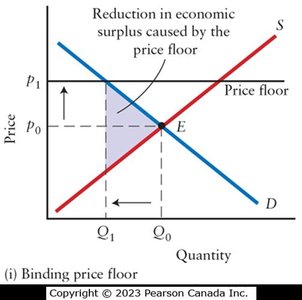
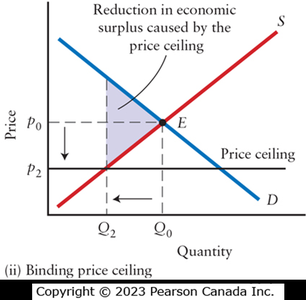
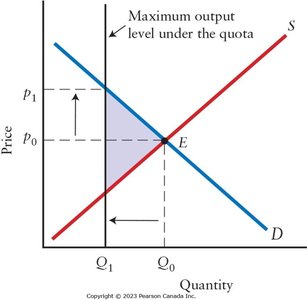
Binding price floors, price ceilings, and output quotas reduce economic surplus and create deadweight loss, which is the loss of total surplus to society.
Deadweight Loss: The reduction in economic surplus caused by market interventions.
Binding Price Floor: Reduces output and surplus.
Binding Price Ceiling: Reduces output and surplus.
Output Quota: Restricts output, raises price, and reduces surplus.
Normative vs. Positive Analysis
Government interventions are often motivated by the desire to help specific groups, even if they create inefficiencies. Economists distinguish between positive analysis (what is) and normative analysis (what ought to be).
Positive Analysis: Focuses on actual effects of policies.
Normative Judgement: Involves value-based decisions about what is desirable.
Social Responsibility: Sometimes prioritized over efficiency.
Debate over Price Gouging
During emergencies, price controls are debated. Economists argue higher prices improve efficiency and welfare, while others emphasize public virtue and fairness. There is no universally correct answer without normative judgement.
Efficiency: Higher prices encourage conservation and increased supply.
Public Virtue: Pursuit of profit during crises may be seen as unacceptable.
Key Formulas and Concepts
Economic Surplus:
Deadweight Loss:
Summary Table: Effects of Price Controls
Type of Control | Effect on Quantity | Effect on Price | Market Outcome |
|---|---|---|---|
Price Floor | Excess Supply | Higher than equilibrium | Unemployment, surplus |
Price Ceiling | Excess Demand | Lower than equilibrium | Shortage, hidden markets |
Rent Control | Shortage of rental units | Lower rents | Existing tenants benefit, landlords and future tenants lose |
Output Quota | Reduced output | Higher price | Deadweight loss |
Additional info: These notes expand on the brief points in the original slides, providing definitions, examples, and academic context for microeconomics students.
