 Back
Price Controls and Market Efficiency: Microeconomics Study Notes
Study Guide - Smart Notes
 Tailored notes based on your materials, expanded with key definitions, examples, and context.
Price Controls and Market Efficiency
Government-Controlled Prices
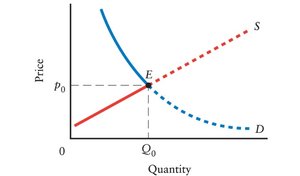
Government intervention in markets often takes the form of price controls, which can lead to disequilibrium. In a voluntary market, transactions occur only when both buyers and sellers agree. When the market is not at equilibrium, the actual quantity exchanged is determined by the lesser of quantity demanded and quantity supplied.
Disequilibrium Price: Occurs when the market price is not at equilibrium, resulting in either excess supply or excess demand.
Quantity Exchanged: Determined by the lower of quantity demanded or supplied at disequilibrium prices.
Equilibrium: The point where quantity demanded equals quantity supplied.
Price Floors
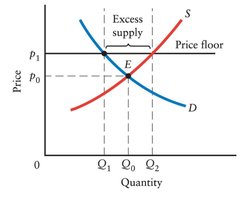
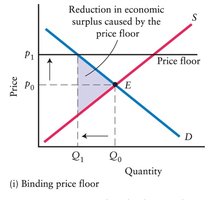
A price floor is the minimum legal price for a good or service. When set above the equilibrium price, it is binding and leads to excess supply.
Binding Price Floor: Results in a surplus, as quantity supplied exceeds quantity demanded.
Example: Minimum wage laws are a price floor in the labor market, often causing unemployment.
Minimum Wages and Unemployment
Some workers benefit by earning higher wages.
Others lose their jobs due to reduced demand for labor.
Firms face higher costs and may reduce employment.
Price Ceilings
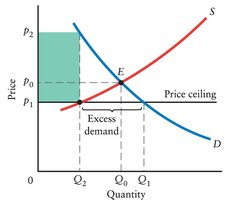
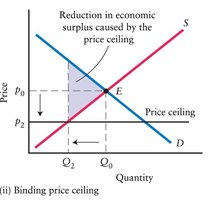
A price ceiling is the maximum legal price for a good or service. When set below equilibrium, it is binding and leads to excess demand.
Binding Price Ceiling: Results in shortages, as quantity demanded exceeds quantity supplied.
Allocation Methods: May include first-come, first-served, rationing, or black markets.
Black Markets: Arise when goods are sold illegally above the price ceiling.
Goals of Price Ceilings
Restrict production
Keep prices low
Promote equity in consumption
Rent Controls: A Case Study of Price Ceilings
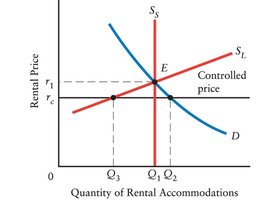
Rent controls are a specific form of price ceiling applied to rental housing markets. They typically result in shortages and alternative allocation schemes.
Shortage: Quantity demanded exceeds quantity supplied.
Long-Run Effects: Supply decreases further, worsening shortages.
Black Markets: May emerge for rental units.
Rent Controls in Ontario
Instituted in 1975, with periodic adjustments.
Led to shortages, especially in urban areas.
Policy changes have included exemptions and expanded controls.
Who Gains and Who Loses?
Gainers: Existing tenants benefit from lower rents.
Losers: Landlords and potential future tenants suffer from reduced supply and investment returns.
Policy Alternatives
Government subsidies for housing production
Direct income assistance to households
All alternatives involve resource costs
Market Efficiency
Economic Surplus and Market Efficiency
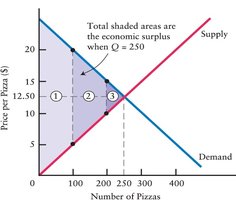
Economists use the concept of market efficiency to evaluate the overall benefits and costs of price controls. Efficiency is achieved when total economic surplus is maximized.
Demand Curve: Represents the value consumers place on each unit.
Supply Curve: Represents the cost to producers for each unit.
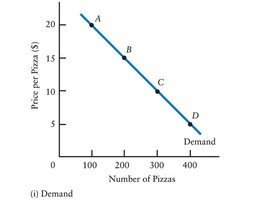
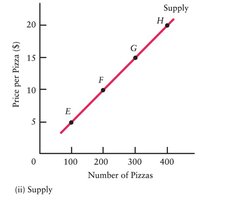
For each unit, the difference between the value to consumers and the cost to producers is the economic surplus.
Market Inefficiency with Price Controls
Binding price floors and ceilings reduce economic surplus, creating deadweight loss and market inefficiency.
Deadweight Loss: The reduction in total economic surplus due to price controls.
Free Market: Maximizes economic surplus at equilibrium.
Output Quotas
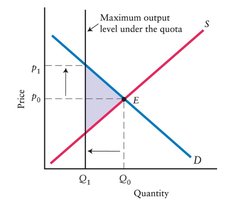
An output quota restricts the total quantity produced, leading to higher prices and reduced economic surplus.
Binding Output Quota: Reduces output and creates deadweight loss.
Normative vs. Positive Analysis
Government interventions are often motivated by the desire to help specific groups, even if they cause inefficiency. Economists distinguish between normative analysis (what ought to be) and positive analysis (what is).
Normative Judgements: Policymakers may accept inefficiency to achieve social goals.
Positive Analysis: Economists focus on actual effects of policies.
Summary Table: Effects of Price Controls
Type of Control | Effect on Market | Winners | Losers |
|---|---|---|---|
Price Floor | Excess supply, deadweight loss | Suppliers who sell at higher price | Consumers, unsold suppliers |
Price Ceiling | Excess demand, deadweight loss | Consumers who buy at lower price | Suppliers, consumers unable to buy |
Rent Control | Housing shortage, black markets | Existing tenants | Landlords, future tenants |
Output Quota | Reduced output, higher price, deadweight loss | Firms with quota | Consumers, excluded firms |
Key Formulas
Economic Surplus: $ \text{Economic Surplus} = \text{Consumer Surplus} + \text{Producer Surplus} $
Deadweight Loss: $ \text{Deadweight Loss} = \text{Total Surplus}_{\text{free market}} - \text{Total Surplus}_{\text{controlled market}} $
