 Back
Price Searching, Market Structures, and Price Discrimination in Microeconomics
Study Guide - Smart Notes
 Tailored notes based on your materials, expanded with key definitions, examples, and context.
Market Structures and Price Searching
Price Taker vs. Price Searcher
In microeconomics, firms are classified based on their ability to influence market prices. This distinction is crucial for understanding how firms behave in different market structures.
Price Takers: Firms in perfectly competitive markets that accept the market price as given. They face a flat (perfectly elastic) demand curve.
Price Searchers: Firms in imperfectly competitive markets (monopolistic competition, oligopoly, monopoly) that have some control over the price they charge. They face a downward-sloping demand curve.
Reasons why demand is not perfectly elastic for price searchers include:
Imperfect information among consumers about products, prices, and quality
Different firm locations leading to varying travel costs
Product differentiation and consumer preference differences
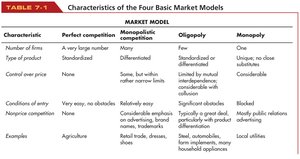
Monopoly: A market with a single firm, often due to legal barriers, unique resources, or natural monopoly conditions (e.g., utilities, public transit). Natural monopolies arise when high fixed costs lead to ever-decreasing average costs, making it most efficient for one firm to serve the market.
Marginal Revenue and Profit Maximization
Marginal Revenue Curve
The marginal revenue (MR) curve is essential for understanding how price-searching firms make output and pricing decisions.
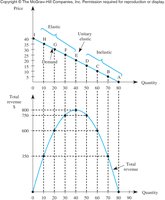
Price Taker: Faces a flat demand curve, so .
Price Searcher: Faces a downward-sloping demand curve, so .
For a straight-line demand curve: The marginal revenue curve:
Recall: MR is the slope of the total revenue (TR) curve.
Profit Maximization for Price Searchers
Price-searching firms maximize profit where marginal revenue equals marginal cost (). This determines the profit-maximizing quantity () and price ().
Profit maximization:
Efficiency:
For price searchers, , so intersects before the demand curve, resulting in
At , , indicating deadweight loss (DWL) due to unrealized gains from trade
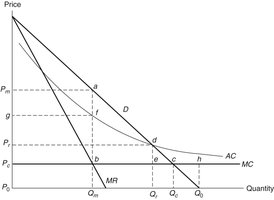
Special Case: If cost = 0, profit is maximized when (total revenue maximization), which occurs at a higher quantity and lower price than profit maximization.
Profit Calculation
The profit () for a firm is given by:
In the long run, entry and exit drive profit to zero for price searchers in monopolistic competition ().
Regulation of Natural Monopoly
Natural monopolies are often regulated to prevent excessive pricing and ensure efficiency.
MC Pricing (Socially Optimal): Set price equal to marginal cost for allocative efficiency.
AC Pricing (Fair-Return): Set price equal to average cost to allow the firm to cover costs and earn a normal profit.
Price Discrimination
Definition and Rationale
Price discrimination occurs when a firm charges different prices to different consumers for reasons not related to cost differences. This allows firms to capture more consumer surplus and increase profits.
Single-price monopoly leaves unrealized gains from trade (DWL).
Price discrimination can exhaust more gains from trade.
Examples of Price Discrimination
Student discounts (U-Pass, student dental plans)
Senior discounts (movie tickets, public transit)
Coupons, advanced booking discounts, and time-based pricing
Types of Price Discrimination
First-degree (Perfect) Price Discrimination: Charging each consumer their maximum willingness to pay for every unit. Consumer surplus is eliminated, and all gains from trade go to the firm.
Second-degree Price Discrimination: Charging different prices for different quantities or blocks (e.g., bulk discounts, cell phone plans, menu pricing).
Third-degree (Ordinary) Price Discrimination: Charging different prices to different identifiable groups (e.g., students, seniors, business vs. residential customers). The group with lower elasticity of demand pays a higher price.
Necessary conditions for third-degree price discrimination:
Ability to identify sub-markets with different elasticities
Ability to prevent resale (arbitrage) between groups
Two-Part Pricing
Definition and Application
Two-part pricing (or two-part tariff) involves charging a lump-sum entry fee plus a per-unit price. This strategy allows firms to extract more consumer surplus, similar to perfect price discrimination.
Examples: Amusement parks (entry + ride fee), nightclubs (cover + drinks), internet service (installation + monthly fee), golf courses (membership + green fees)
Optimal strategy: Set per-unit price equal to marginal cost () and entry fee equal to consumer surplus.
Limitations:
Uniform entry fees may deter low-demand consumers
Works best with homogeneous consumers; with heterogeneous consumers, price discrimination may be more effective
Example: Costco (membership + price) vs. Superstore (no membership fee)
