 Back
BackPricing Strategies and Advertising in Monopoly and Market Power
Study Guide - Smart Notes
 Tailored notes based on your materials, expanded with key definitions, examples, and context.
Pricing and Advertising Strategies for Firms with Market Power
Introduction to Pricing Strategies
Firms with market power, such as monopolists or oligopolists, can influence prices and output to maximize profits. Unlike perfectly competitive firms, these firms may set different prices for different consumers or groups, a practice known as price discrimination. The main objective of advanced pricing strategies is to capture consumer surplus and convert it into additional profit for the firm.
Consumer Surplus: The difference between what consumers are willing to pay and what they actually pay.
Profit Maximization: Firms choose prices, output, and input quantities to maximize profits in both the short and long run.
Price Discrimination
Price discrimination is the practice of selling the same good at different prices to different customers, even when production costs are identical. This strategy is only feasible for firms with market power and is designed to increase profits by charging prices closer to each consumer's willingness to pay.
Conditions for Price Discrimination:
The firm must have market power.
The firm must be able to segment the market (e.g., by age, location, or income).
Arbitrage must be prevented (consumers cannot resell the good easily).
Economic Welfare: Price discrimination can increase total output and reduce deadweight loss, but the additional surplus accrues to the producer.
Types of Price Discrimination
Perfect Price Discrimination (First-Degree): The monopolist charges each consumer their exact willingness to pay, capturing all consumer surplus as profit. In this case, the efficient quantity is produced, and there is no deadweight loss, but consumer surplus is zero.
Imperfect Price Discrimination: The firm charges different prices to groups or for different quantities, but not perfectly individualized prices. Total surplus may increase, decrease, or remain unchanged compared to single-price monopoly.
Examples: Movie tickets (student/senior discounts), airline tickets, coupons, financial aid, and quantity discounts.
Mathematical Example: Price Discrimination in Two Markets
Suppose a monopolist faces two markets with demands: and , and marginal cost .
Profit maximization requires setting marginal revenue equal to marginal cost in each market:
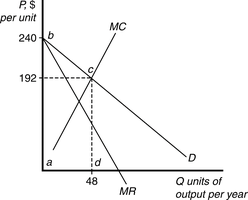
Graphical Representation of Perfect Price Discrimination
The following figure illustrates perfect price discrimination, where the monopolist produces at the point where marginal cost equals demand, capturing all surplus:
Two-Part Tariffs and Bundling
Firms may use two-part tariffs or bundling to extract more consumer surplus. A two-part tariff requires a fixed fee plus a per-unit price, while bundling involves selling products together as a package.
Two-Part Tariff: Consumers pay an entry fee plus a per-unit price. Example: Club memberships with per-use charges.
Bundling: Products are sold only as a package. Example: "All you can eat" buffets, season tickets including pre-season games.
Product Tie-In: A low price for one product is conditional on purchasing another (e.g., "kids eat free" with paying adult).
Advertising by Firms with Market Power
Firms with differentiated products often use advertising to increase demand and market share. The extent of advertising depends on the degree of product differentiation and market structure.
Advertising Expenditure: Highly differentiated consumer goods: 10-20% of revenue; industrial goods: little; undifferentiated goods: none.
Debate on Social Value:
Critics: Advertising manipulates tastes, increases brand loyalty, and reduces competition.
Defenders: Advertising provides information, increases competition, and can lower prices.
Applications and Problem Solutions
Block Pricing: Charging one price for an initial block of units and a different price for additional units. Surplus is maximized when output equals the quantity where demand equals marginal cost.
Elasticity and Pricing: The optimal markup is inversely related to the price elasticity of demand. More elastic consumers receive greater discounts.
Market Segmentation: Coupons and loyalty cards allow firms to segment markets and extract more surplus from less price-sensitive consumers.
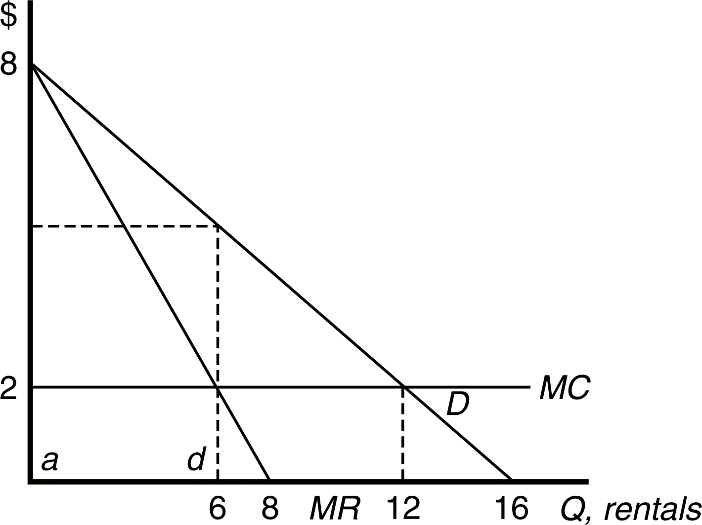
Graphical Example: Two-Part Tariff and Consumer Surplus
The following figure shows how a two-part tariff can extract all consumer surplus by charging a flat fee plus a per-unit price equal to marginal cost:
Key Formulas and Concepts
Monopoly Profit Maximization: Set to find optimal output and price.
Price Discrimination: Set in each segmented market .
Elasticity-Based Pricing: , where is the price elasticity of demand.
Block Pricing Surplus: , where is the efficient quantity.
Summary Table: Types of Price Discrimination
Type | Description | Example | Consumer Surplus | Deadweight Loss |
|---|---|---|---|---|
First-Degree (Perfect) | Each consumer pays their maximum willingness to pay | Personalized pricing | Zero | Zero |
Second-Degree (Block) | Price varies by quantity purchased | Bulk discounts | Reduced | Reduced |
Third-Degree (Group) | Price varies by consumer group | Student/senior discounts | Reduced | Reduced |
Conclusion
Pricing strategies such as price discrimination, two-part tariffs, and bundling allow firms with market power to increase profits by capturing consumer surplus. Advertising plays a key role in differentiated markets, influencing both demand and competition. Understanding these strategies is essential for analyzing firm behavior and market outcomes in microeconomics.
