 Back
BackProduction Possibilities Frontier (PPF) and Market Graphs: Microeconomics Exam Review Guidance
Study Guide - Smart Notes
 Tailored notes based on your materials, expanded with key definitions, examples, and context.
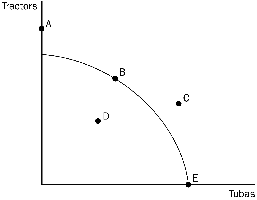
Q11. On the production possibilities frontier shown, the economy can produce at which point or points?
Background
Topic: Production Possibilities Frontier (PPF)
This question tests your understanding of feasible production points on the PPF, which represents the maximum possible combinations of two goods that an economy can produce given its resources and technology.
Key Terms and Concepts:
Production Possibilities Frontier (PPF): A curve showing the maximum attainable combinations of two products that may be produced with available resources and current technology.
Feasible Points: Points on or inside the PPF are attainable; points outside are unattainable.
Step-by-Step Guidance
Identify which points are on the PPF curve and which are inside or outside the curve.
Recall that any point on the curve or inside the curve is feasible (can be produced with available resources).
Check each labeled point (A, B, C, D, E) to see if it lies on or inside the curve.
Remember, points outside the curve are unattainable with current resources.
Try solving on your own before revealing the answer!
Q12. On the production possibilities frontier shown, which point or points are efficient?
Background
Topic: Productive Efficiency on the PPF
This question tests your understanding of efficiency, specifically which points on the PPF represent the most efficient use of resources.
Key Terms and Concepts:
Productive Efficiency: Achieved when the economy is producing on the PPF; all resources are fully and efficiently utilized.
Inefficiency: Points inside the PPF indicate underutilization of resources.
Step-by-Step Guidance
Recall that efficiency means producing the maximum output possible with given resources.
Identify which points are exactly on the PPF curve (not inside or outside).
Understand that only points on the curve are efficient; points inside are inefficient, and points outside are unattainable.
Check each labeled point to determine if it is on the curve.
Try solving on your own before revealing the answer!
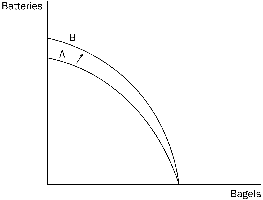
Q13. In the production possibilities frontier shown, the shift of the frontier from A to B was most likely caused by which of the following?
Background
Topic: Economic Growth and Shifts in the PPF
This question tests your understanding of what causes the PPF to shift outward, indicating an increase in an economy's productive capacity.
Key Terms and Concepts:
Outward Shift of PPF: Represents economic growth—an increase in resources, labor, or technology.
General vs. Specific Growth: General growth shifts the entire curve; specific growth shifts only one axis.
Step-by-Step Guidance
Observe that the entire PPF has shifted outward from A to B.
Recall that a general outward shift means the economy can produce more of both goods.
Consider what could cause this: more resources, better technology, or an increase in labor or capital.
Eliminate options that would only affect one good or shift only one axis.
Try solving on your own before revealing the answer!
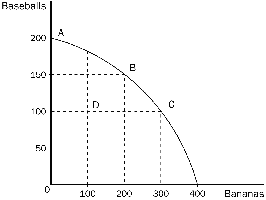
Q14. In the production possibilities frontier shown, what is the opportunity cost to society of the movement from point A to point C?
Background
Topic: Opportunity Cost on the PPF
This question tests your ability to calculate opportunity cost using the PPF, specifically the trade-off between two goods when moving from one point to another on the curve.
Key Terms and Concepts:
Opportunity Cost: The value of the next best alternative foregone when making a choice.
PPF Trade-offs: Moving along the PPF involves giving up some of one good to gain more of another.
Step-by-Step Guidance
Identify the coordinates for points A and C (quantities of baseballs and bananas at each point).
Calculate the change in the number of baseballs and bananas as you move from A to C.
The opportunity cost of moving from A to C is the amount of baseballs given up to gain more bananas.
Subtract the number of baseballs at C from the number at A to find the loss in baseballs.
Try solving on your own before revealing the answer!
Q15. In the production possibilities frontier shown, the movement from point C to point D was most likely caused by
Background
Topic: Inefficiency and Shifts Inside the PPF
This question tests your understanding of what causes an economy to operate inside its PPF, such as unemployment or underutilization of resources.
Key Terms and Concepts:
Point Inside the PPF: Indicates inefficiency—resources are not fully employed.
Causes: Unemployment, underused resources, or other inefficiencies.
Step-by-Step Guidance
Notice that point D is inside the PPF, while point C is on the curve.
Recall that moving from the curve to inside the curve means the economy is not using all its resources efficiently.
Consider what could cause this: unemployment, fewer resources, or inefficiency.
Review the answer choices for the one(s) that match this scenario.
Try solving on your own before revealing the answer!
