 Back
Production Possibilities, Opportunity Cost, and Comparative Advantage: Tools for Microeconomics
Study Guide - Smart Notes
 Tailored notes based on your materials, expanded with key definitions, examples, and context.
Tools for Economists
Production Possibilities Frontier (PPF)
The Production Possibilities Frontier (PPF) is a fundamental model in microeconomics that illustrates the maximum combinations of two goods a society can produce at full employment. It is used to analyze trade-offs, opportunity costs, and efficiency in production.
PPF Definition: The boundary between attainable and unattainable production combinations.
Efficient Production: All points on the PPF are productively efficient; resources are fully utilized.
Inefficient Production: Points inside the PPF are attainable but inefficient; resources are underutilized.
Unattainable Production: Points outside the PPF cannot be achieved with current resources.
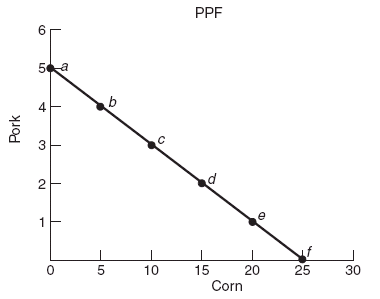
Example: If a society can produce either guns or butter, the PPF shows the trade-off between these two goods. Moving along the PPF, producing more of one good requires sacrificing production of the other.
Opportunity Cost
Opportunity cost is the value of the next best alternative foregone when making a choice. On the PPF, it is measured by how much of one good must be given up to produce more of another.
Calculation: Opportunity cost increases as production specializes due to resources not being perfectly adaptable.
Formula:
Increasing Opportunity Cost: Most resources are not equally efficient in all uses, so shifting resources increases opportunity cost.
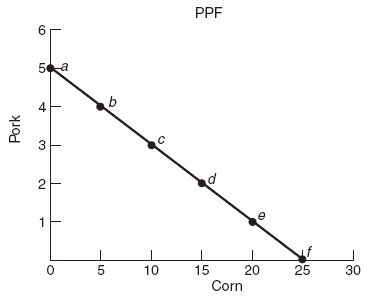
Example: To produce one more unit of butter, two units of guns must be given up.
Production Efficiency and Allocative Efficiency
Production efficiency occurs when it is impossible to produce more of one good without producing less of another. Allocative efficiency is achieved when the mix of goods produced is most desirable to society, where marginal benefit equals marginal cost ().
Marginal Benefit (MB): The additional benefit from consuming one more unit of a good.
Marginal Cost (MC): The additional cost of producing one more unit of a good.
Allocative Efficiency: Achieved at the point on the PPF where .
Economic Growth and Shifts in the PPF
Economic Growth
Economic growth is represented by an outward shift of the PPF, indicating an increase in the economy's capacity to produce goods and services. Growth can result from expanding resources (such as capital accumulation and human capital) or technological improvements.
Outward Shift: Indicates more production is possible.
Inward Shift: May occur due to recession or loss of resources.
Trade-off: Investing in capital goods reduces current consumption but increases future production.

Example: During a recession, a country may produce inside its PPF, indicating underutilized resources.
Specialization, Comparative Advantage, and Trade
Specialization and Trade
Specialization occurs when individuals or nations focus on producing goods for which they have a comparative advantage. Trade allows all parties to benefit by consuming beyond their own PPF.
Specialization: Increases total production and efficiency.
Trade: Enables consumption outside the PPF.

Comparative Advantage
Comparative advantage is the ability to produce a good at a lower opportunity cost than another producer. It is the foundation for mutually beneficial trade.
Absolute Advantage: Ability to produce more of a good with the same resources.
Comparative Advantage: Lower opportunity cost in production.
Key Principle: Even if one country has an absolute advantage in all goods, both countries can benefit from trade if they specialize according to comparative advantage.

Example: Germany specializes in car manufacturing and imports toys from Mexico, even if Germany can produce both goods more efficiently. Mexico has a lower opportunity cost for toy production.
Determining Comparative Advantage
To decide who should produce what, compare opportunity costs between nations. The country with the lower opportunity cost for a good should specialize in its production.
Formula:
Example Table:
Country | Opportunity Cost of Oil (in Silicon Chips) |
|---|---|
United States | 1 |
Mexico | 0.4 |
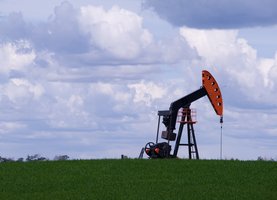
Conclusion: Mexico has a comparative advantage in oil production and should export oil to the United States.
The Gains from Trade
Trade allows countries to specialize and consume more than they could produce alone. Both countries gain from trade by splitting the extra output produced through specialization.
Before Trade: Each country produces and consumes within its PPF.
After Trade: Both countries can consume outside their PPF.
Trade Barriers and Institutions
Trade Barriers
Trade barriers include transportation costs, communication costs, and government-imposed restrictions. While these costs have decreased over time, barriers still exist and can limit the gains from trade.
Diminishing Returns: Complete specialization can make countries vulnerable.
Government Intervention: Sometimes used to protect industries or respond to recessions.
Economic Institutions
To realize the gains from trade, societies rely on key economic institutions that coordinate production and exchange:
Firms: Organize production.
Markets: Facilitate exchange.
Property Rights: Ensure ownership and incentives.
Money: Medium of exchange.
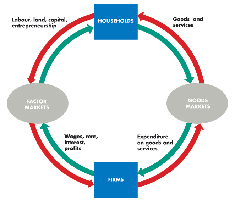
Example: The circular flow diagram shows how households and firms interact in factor and goods markets, with money flowing in the opposite direction to goods and services.
Key Concepts Summary
Production Efficiency
PPF (Production Possibilities Frontier)
Opportunity Cost
Absolute Advantage
Comparative Advantage
Economic Growth
