 Back
Production Possibilities, Opportunity Cost, and Comparative Advantage: Tools for Economists
Study Guide - Smart Notes
 Tailored notes based on your materials, expanded with key definitions, examples, and context.
Tools for Economists
Production Possibilities Frontier (PPF)
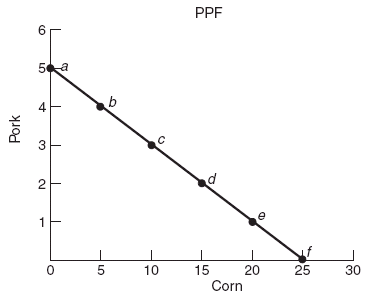
The Production Possibilities Frontier (PPF) is a fundamental model in microeconomics that illustrates the maximum combinations of two goods a society can produce at full employment, given its resources and technology. The PPF helps economists analyze trade- offs, opportunity costs, and efficiency in production.
Definition: The PPF is a curve showing all possible combinations of two goods that can be produced when resources are fully and efficiently utilized.
Efficiency: Points on the PPF are productively efficient; points inside are inefficient, and points outside are unattainable.
Trade-offs: Moving along the PPF involves shifting resources from one good to another, illustrating the concept of opportunity cost.
Example: If a society produces only guns and butter, the PPF shows the maximum possible output of each, given the available resources.
Opportunity Cost
Opportunity cost is the value of the next best alternative foregone when a choice is made. On the PPF, opportunity cost is represented by the amount of one good that must be given up to produce more of another good.
Calculation: Opportunity cost is calculated as the slope of the PPF.
Increasing Opportunity Cost: In most cases, resources are not perfectly adaptable, so opportunity cost increases as production of one good is specialized.
Formula:
Production Efficiency and Allocative Efficiency
Production efficiency occurs when it is impossible to produce more of one good without producing less of another. Allocative efficiency is achieved when the mix of goods produced is most desirable to society, where marginal benefit equals marginal cost ().
Marginal Benefit (MB): The additional benefit from consuming one more unit of a good.
Marginal Cost (MC): The additional cost of producing one more unit of a good.
Allocative Efficiency Condition:
Economic Growth and Shifts in the PPF
Economic growth is represented by an outward shift of the PPF, indicating an increase in the economy's capacity to produce goods and services. Growth can result from expanding resources (such as capital accumulation and human capital) or technological improvements.
Outward Shift: Indicates economic growth.
Inward Shift: May occur due to recession or loss of resources.
Trade-off: Investing in capital goods reduces current consumption but increases future production possibilities.

Specialization, Comparative Advantage, and Trade
Specialization and Trade
Specialization occurs when individuals or nations focus on producing goods for which they have a comparative advantage. Trade allows all parties to benefit by consuming beyond their own PPF.
Definition: Comparative advantage is the ability to produce a good at a lower opportunity cost than others.
Absolute Advantage: The ability to produce more of a good with the same resources.
Gains from Trade: Both parties can consume more than they could without trade.

Comparative vs. Absolute Advantage
Even if one country has an absolute advantage in producing all goods, trade can still be beneficial if countries specialize according to their comparative advantage.
Example: If Germany can produce more cars and toys than Mexico, but Mexico has a lower opportunity cost for oil, Mexico should specialize in oil and Germany in cars.
Opportunity Cost Comparison: silicon chip; silicon chip.
Gains from Trade
Trade enables countries to consume outside their own PPF, increasing overall welfare. The extra output produced through specialization is shared, resulting in mutual gains.
Before Trade: Each country produces and consumes within its own PPF.
After Trade: Both countries can consume more by specializing and trading.
Economic Institutions for a Better Future
Institutions Facilitating Trade
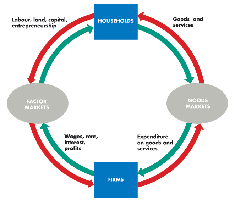
To realize the gains from trade, societies rely on institutions that coordinate economic activity. These include firms, markets, property rights, and money.
Firms: Organize production and employ resources.
Markets: Facilitate exchange between buyers and sellers.
Property Rights: Ensure ownership and incentivize investment.
Money: Serves as a medium of exchange, simplifying transactions.
Trade Barriers and Costs
While trade offers significant benefits, it also involves costs such as transportation, communication, and vulnerability to external shocks. Governments may impose trade barriers to protect certain industries or respond to economic downturns.
Trade Barriers: Tariffs, quotas, and regulations that restrict trade.
Diminishing Returns: Complete specialization can expose economies to risks.
Key Concepts Summary
Production Efficiency
PPF (Production Possibilities Frontier)
Opportunity Cost
Absolute Advantage
Comparative Advantage
Economic Growth
