 Back
BackProduction Possibilities, Opportunity Cost, and Gains from Trade: Microeconomics Study Notes
Study Guide - Smart Notes
 Tailored notes based on your materials, expanded with key definitions, examples, and context.
Production Possibilities Frontier (PPF)
Definition and Purpose
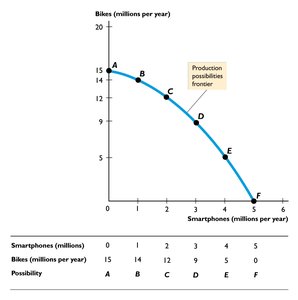
The Production Possibilities Frontier (PPF) is a fundamental concept in microeconomics that illustrates the maximum combinations of goods and services that can be produced given available resources and technology. The PPF is used to demonstrate scarcity, tradeoffs, and efficiency in production.
Scarcity: The PPF shows the limits to production, highlighting that resources are finite.
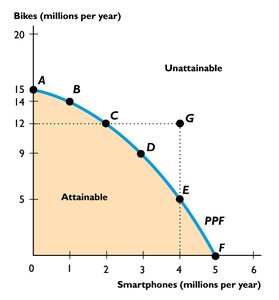
Combinations: Points on or inside the PPF are attainable; points outside are unattainable.
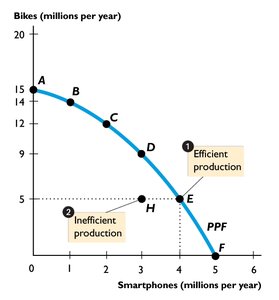
Efficiency: Production is efficient when it is on the PPF; inefficient when inside the PPF.
Attainable and Unattainable Combinations
The PPF separates attainable combinations (on or inside the frontier) from unattainable combinations (outside the frontier).
Attainable: Any point on or inside the PPF.
Unattainable: Any point outside the PPF, such as point G.
Efficient and Inefficient Production
Efficient Production: Occurs at points on the PPF, where resources are fully utilized.
Inefficient Production: Occurs at points inside the PPF, where some resources are underutilized.
Tradeoffs and Free Lunches
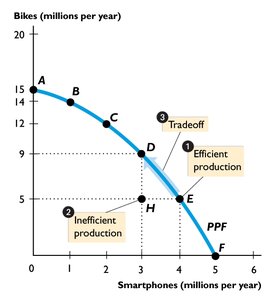
Tradeoff: Moving along the PPF requires giving up some of one good to produce more of another.
Free Lunch: Moving from an inefficient point inside the PPF to the frontier allows more production without tradeoff.
Opportunity Cost
Definition and Calculation
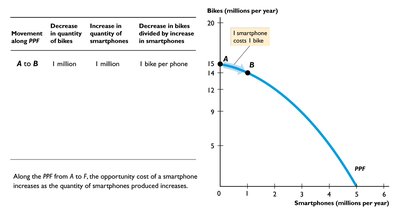
Opportunity cost is the value of the next best alternative forgone when making a choice. On the PPF, it is measured as the decrease in the quantity of one good divided by the increase in the quantity of another as production shifts.
Formula:
Example: Opportunity Cost of Smartphones
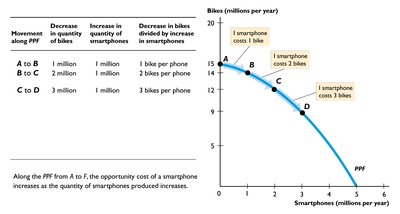
Moving from A to B: 1 smartphone costs 1 bike.
Moving from B to C: 1 smartphone costs 2 bikes.
Moving from C to D: 1 smartphone costs 3 bikes.
Moving from D to E: 1 smartphone costs 4 bikes.
Moving from E to F: 1 smartphone costs 5 bikes.
Increasing Opportunity Cost
As more of one good is produced, the opportunity cost increases. This is reflected in the bowed-out shape of the PPF.
Explanation: Resources are not equally efficient in all uses, so reallocating them increases the cost.
Opportunity Cost and the Slope of the PPF
The slope of the PPF at any point measures the opportunity cost of the good on the horizontal axis.
Steeper Slope: Higher opportunity cost.
Bowed Outward: Indicates increasing opportunity cost.
Opportunity Cost as a Ratio
Opportunity cost of a smartphone: bikes forgone per smartphone gained.
Opportunity cost of a bike: smartphones forgone per bike gained.
If opportunity cost of a smartphone is x bikes, then opportunity cost of a bike is 1/x smartphones.
Economic Growth
Definition and Effects
Economic growth is the sustained expansion of production possibilities, often due to improved technology, better labor quality, or increased capital.
Effect: The PPF shifts outward, allowing more production of both goods.
Example: Building more factories increases future production possibilities.
Specialization and Trade
Absolute and Comparative Advantage
Absolute Advantage: The ability to produce more output with the same resources.
Comparative Advantage: The ability to produce a good at a lower opportunity cost than others.
Example: Liz and Joe
Liz: 1 smoothie costs 1 salad; 1 salad costs 1 smoothie.
Joe: 1 smoothie costs 5 salads; 1 salad costs 1/5 smoothie.
Liz has comparative advantage in smoothies; Joe in salads.
Gains from Trade
When individuals or nations specialize in goods for which they have a comparative advantage and trade, both can achieve consumption beyond their individual PPFs.
Specialization: Liz produces 30 smoothies, Joe produces 30 salads.
Trade: Liz sells Joe 10 smoothies and buys 20 salads; Joe sells Liz 10 salads and buys 20 smoothies.
Result: Both gain 5 smoothies and 5 salads per hour.
Application: Wind Power and Opportunity Cost
Is Wind Power Free?
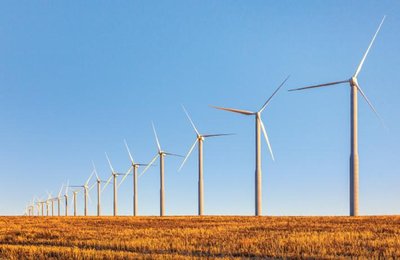
Wind power is not free; its opportunity cost includes the goods and services forgone to build turbines and transmission lines.
Production Efficiency: Point A is efficient electricity production.
Inefficiency: Producing most electricity with wind power may place the economy inside the PPF, at a point such as Z.
Summary Table: Opportunity Cost Along the PPF
Movement along PPF | Decrease in quantity of bikes | Increase in quantity of smartphones | Decrease in bikes divided by increase in smartphones |
|---|---|---|---|
A to B | 1 million | 1 million | 1 bike per phone |
B to C | 2 million | 1 million | 2 bikes per phone |
C to D | 3 million | 1 million | 3 bikes per phone |
D to E | 4 million | 1 million | 4 bikes per phone |
E to F | 5 million | 1 million | 5 bikes per phone |
Key Terms
Production Possibilities Frontier (PPF): The boundary between attainable and unattainable production combinations.
Opportunity Cost: The value of the next best alternative forgone.
Production Efficiency: Using all resources so that more of one good cannot be produced without less of another.
Comparative Advantage: Producing a good at a lower opportunity cost than others.
Absolute Advantage: Producing more output with the same resources.
Tradeoff: Giving up one thing to get another.
Free Lunch: Getting something without giving up anything else.
Additional info: Academic context and examples were expanded for clarity and completeness.
