 Back
Public Goods and Externalities: Microeconomics Study Guide
Study Guide - Smart Notes
 Tailored notes based on your materials, expanded with key definitions, examples, and context.
Market Failure: Public Goods and Externalities
Introduction to Market Failure
Market failure occurs when the allocation of goods and services by a free market is not efficient. This module focuses on two major sources of market failure: public goods and externalities. Understanding these concepts is essential for analyzing situations where markets do not achieve socially optimal outcomes.
The Types of Goods
Characteristics of Goods: Rivalry and Excludability
Goods are classified based on two main characteristics: rivalry and excludability.
Rivalrous: Consumption by one person reduces the availability for others (e.g., ice cream).
Non-rivalrous: Consumption by one person does not affect others (e.g., national defense).
Excludable: People can be prevented from using the good (e.g., club membership).
Non-excludable: It is difficult or impossible to prevent anyone from using the good (e.g., public parks).
Based on these characteristics, goods are classified as:
Private Goods: Rivalrous and excludable (e.g., your computer).
Club Goods: Non-rivalrous but excludable (e.g., swimming pools).
Common Goods: Rivalrous but non-excludable (e.g., fisheries).
Public Goods: Non-rivalrous and non-excludable (e.g., traffic lights).
Congestion can affect non-rivalrous goods, making them rivalrous when overused.
The Free Rider Problem
The free rider problem arises when individuals benefit from a good without paying for it, which is common with public goods due to their non-excludability. This often leads to under-provision of such goods by private markets.
Market Demand for Private vs Public Goods
Aggregation of Demand
The method of aggregating individual demand differs between private and public goods:
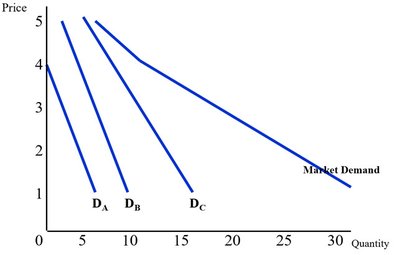
Private Goods: Individual demand curves are summed horizontally to obtain the market demand curve. This shows the total quantity demanded at each price.
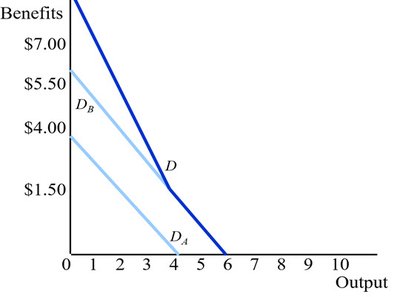
Public Goods: Individual demand curves are summed vertically. For each quantity, the willingness to pay (reservation price) of all consumers is added to determine the total value placed on that quantity.
Example: For private goods, if three consumers each demand 5 units at $2, the market demand at $2 is 15 units. For public goods, if three consumers are willing to pay $2, $3, and $4 for 1 unit, the total willingness to pay for 1 unit is $9.
Using Algebra to Decide on Public Good Provision
Algebraic Approach
To determine the optimal provision of a public good, aggregate the willingness to pay of all consumers and compare it to the marginal cost (MC) of provision.
Given individual demand functions: A: Q = 20 - 4P, B: Q = 18 - 2P
Marginal cost: MC = $5
Aggregate demand vertically: For each quantity, sum the prices each consumer is willing to pay.
Equilibrium: The quantity where aggregate willingness to pay equals MC.
Formula: For public goods, at each quantity Q, total willingness to pay = PA + PB + ... + Pn. Set this equal to MC to find the optimal Q.
Example Table:
Q | PA | PB | MSB | MC |
|---|---|---|---|---|
1 | 4.75 | 8.5 | 13.25 | 5 |
2 | ... | ... | ... | 5 |
... | ... | ... | ... | 5 |
Additional info: The table above is a simplified version; students should practice filling in the values for different Q.
Externalities
Definition and Types
Externalities occur when the actions of one party affect the well-being of another party, without compensation. They can be:
Positive Externalities: Actions benefit others (e.g., vaccinations, R&D).
Negative Externalities: Actions impose costs on others (e.g., pollution).
Economic efficiency requires that social marginal benefit (SMB) equals social marginal cost (SMC) at the optimal output.
Private Marginal Cost (PMC): Cost to producers.
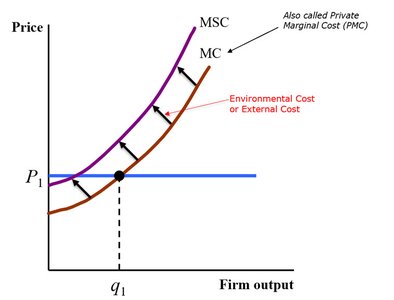
Social Marginal Cost (SMC): PMC plus external costs.
Private Marginal Benefit (PMB): Direct benefit to consumers.
Social Marginal Benefit (SMB): PMB plus external benefits.
Negative Externalities: Overproduction
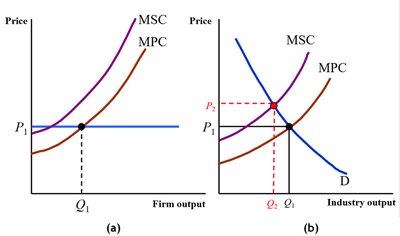
When negative externalities exist, the market produces more than the socially optimal quantity, and prices are lower than they should be. The firm does not account for environmental costs, leading to excess output.
Positive Externalities: Underproduction
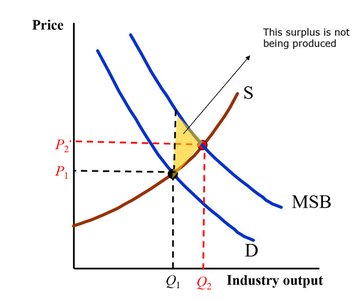
With positive externalities, the market produces less than the socially optimal quantity. The social benefit exceeds the private benefit, so the optimal output is higher than the market output.
Seminal Scholarship on Externalities
Key Theories
Garrett Hardin (1968): "The Tragedy of the Commons"—externalities as a moral problem.
Elinor Ostrom (1990): "Governing the Commons"—externalities as a problem of governance and organization. Ostrom's eight rules emphasize self-governance and community management.
Addressing Over and Underproduction
Policy Solutions
Property Rights and Bargaining: Assigning property rights and allowing negotiation can lead to efficient outcomes (Coase Theorem).
Pigouvian Taxes/Subsidies: Taxes or subsidies equal to the marginal external cost or benefit correct market outcomes.
Regulation: Government sets limits or standards for production.
Tradable Permits: Firms can buy and sell rights to pollute, allowing flexibility and efficiency.
Example: Charging steel mills for emissions and compensating affected residents, or implementing carbon taxes to address climate change.
Policy in Action: Climate Change
Application of Externality Theory
Climate change is a classic example of negative externalities. The costs of greenhouse gas emissions are not reflected in market prices, leading to overproduction of polluting goods. Policy responses include:
Regulation: Standards such as Corporate Average Fuel Economy (CAFE).
Fees: Fuel taxes, carbon taxes.
Tradable Permits: Regional Greenhouse Gas Initiative.
Double Dividend: Emission control and revenue collection.
Additional info: Students should consider the effectiveness and challenges of each policy approach.
