 Back
BackScarcity, Opportunity Cost, Trade, and Economic Models: Foundations of Microeconomics
Study Guide - Smart Notes
 Tailored notes based on your materials, expanded with key definitions, examples, and context.
Scarcity and Choice
Understanding Scarcity
Scarcity is a fundamental concept in economics, arising because resources such as money, time, and energy are limited, while human wants are virtually unlimited. This limitation forces individuals, businesses, and governments to make choices about how to allocate their resources most effectively.
Scarcity: The condition that results from the imbalance between limited resources and unlimited wants.
Choice: Because of scarcity, every decision involves selecting one option over others, leading to trade-offs.
Economics: The study of how people make choices to satisfy their wants and how these choices interact in markets.

Example: Choosing between spending time at the beach or working for extra income illustrates the necessity of making choices due to scarcity.
Scarcity in Everyday Life
Scarcity affects all aspects of life, from daily decisions to large-scale government policies.
Smart choices require evaluating what to pursue and what to give up.
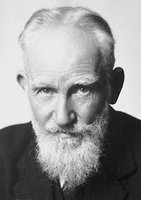
Quote: "Economy is the art of making the most out of life." – George Bernard Shaw
Opportunity Cost
Defining Opportunity Cost
Opportunity cost is the value of the best alternative forgone when a choice is made. It is the most important concept for making smart economic decisions, as it reflects the true cost of any action, not just its monetary cost.
Opportunity Cost: The value of the next best alternative that is given up when a choice is made.
Every choice involves a trade-off due to scarcity.
Smart choices require that the value of what you gain exceeds the value of what you give up.

Example: If you spend an hour studying instead of working, the opportunity cost is the wage you could have earned during that hour.
Incentives and Smart Choices
Incentives are rewards or penalties that influence choices. Positive incentives encourage actions, while negative incentives discourage them. As costs and benefits change, so do the choices people make.
Incentives: Factors that motivate individuals to act in certain ways by offering rewards or penalties.
Smart choices adapt as incentives change.
Gains from Trade and Comparative Advantage
Why Trade Occurs
Trade allows individuals and nations to specialize in activities where they have a comparative advantage, leading to greater overall efficiency and higher standards of living. Voluntary trade benefits all parties involved, as each receives something they value more than what they give up.
Absolute Advantage: The ability to produce more of a good or service with the same amount of resources than another producer.
Comparative Advantage: The ability to produce a good or service at a lower opportunity cost than another producer.
Specialization and trade enable consumption beyond individual production possibilities.
Production Possibilities Frontier (PPF)
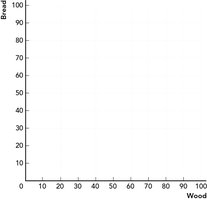
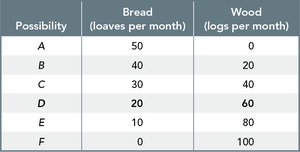
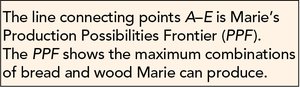
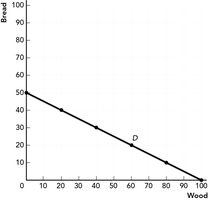
The Production Possibilities Frontier (PPF) is a graph that shows the maximum combinations of two goods or services that can be produced with existing resources and technology. Points on the PPF represent efficient production levels, while points inside the curve are inefficient, and points outside are unattainable without trade.

Possibility | Bread (loaves per month) | Wood (logs per month) |
|---|---|---|
A | 50 | 0 |
B | 40 | 20 |
C | 30 | 40 |
D | 20 | 60 |
E | 10 | 80 |
F | 0 | 100 |
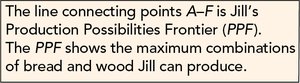
Key Point: The PPF illustrates the concept of opportunity cost, as moving along the curve involves giving up some of one good to gain more of another.
Comparing Production Possibilities
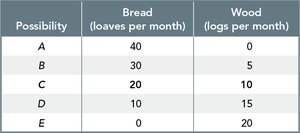
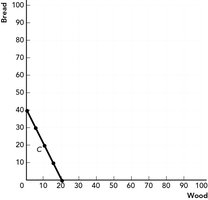
Possibility | Bread (loaves per month) | Wood (logs per month) |
|---|---|---|
A | 40 | 0 |
B | 30 | 5 |
C | 20 | 10 |
D | 10 | 15 |
E | 0 | 20 |
Opportunity Costs and Comparative Advantage
Loaf of Bread | Log of Wood | |
|---|---|---|
Jill | Gives up 2 logs of wood | Gives up 1/2 loaf of bread |
Marie | Gives up 1/2 log of wood | Gives up 2 loaves of bread |
Comparative Advantage | Marie in bread-making | Jill in wood-chopping |
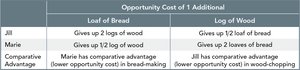
Key Point: Comparative advantage, not absolute advantage, determines who should specialize in which good for maximum gains from trade.
Gains from Specialization and Trade
By specializing according to comparative advantage and trading, both parties can consume combinations of goods that were previously unattainable.
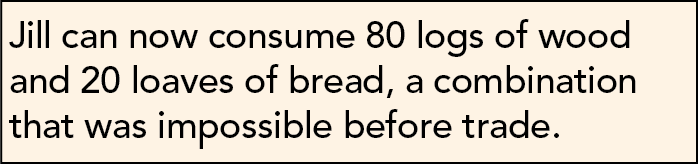
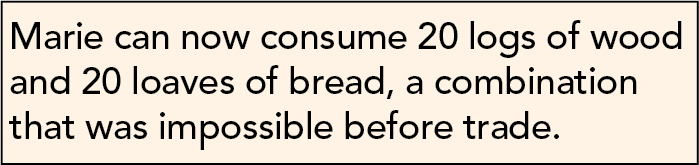
Example: After trade, Jill can consume 80 logs of wood and 20 loaves of bread, and Marie can consume 20 logs of wood and 20 loaves of bread—combinations impossible without trade.
Economic Models and Thinking Like an Economist
The Role of Models in Economics
Economic models are simplified representations of reality that help focus on essential relationships and predict outcomes. The circular-flow model is a foundational tool for understanding how households, businesses, and governments interact in markets.
Model: A simplified framework for describing and analyzing economic processes.
Circular-Flow Model: Illustrates the flow of goods, services, and resources among households, businesses, and governments.
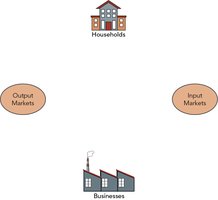
In the circular-flow model:
Households supply inputs (labor, capital, natural resources) to businesses in input markets.
Businesses supply goods and services to households in output markets.
Governments set the rules and may participate in any market.
Microeconomics vs. Macroeconomics
Economics is divided into two main branches:
Microeconomics: Studies the choices of individuals, households, and businesses, and how these choices interact in markets.
Macroeconomics: Examines the performance of the entire economy, including national income, growth, and inflation.


Key Point: Microeconomics focuses on the 'trees' (individual choices), while macroeconomics looks at the 'forest' (the economy as a whole).
Positive vs. Normative Statements
Economists distinguish between positive and normative statements:
Positive Statements: Claims about what is; can be tested and validated with evidence.
Normative Statements: Claims about what ought to be; involve value judgments and cannot be tested for truth.
Example: "Raising the price of gas will reduce consumption" (positive). "The government should raise the price of gas to fight global warming" (normative).
The Three Keys Model for Smart Choices
Making Smart Choices
The Three Keys Model summarizes the core of microeconomics and provides a framework for making rational decisions:
1. Compare additional benefits and opportunity costs
2. Consider how costs and benefits change
3. Account for implicit costs and externalities



Key Point: Smart choices require weighing all relevant costs and benefits, including those not immediately obvious.
Is Economics a Science?
Economics and Scientific Method
Economics uses models and quantitative methods similar to the natural sciences, but its predictive accuracy is often limited by the complexity and variability of human behavior. Economic models are valuable for organizing thinking and making logical predictions, even if they cannot always achieve the precision of physical sciences.
Economic models simplify reality to focus on key relationships.
Models rely on assumptions, such as 'all other things being equal' (ceteris paribus).
Economics involves both positive analysis (what is) and normative analysis (what should be).
Quote: "Economics is a science of thinking in terms of models joined to the art of choosing models which are relevant to the contemporary world." – John Maynard Keynes
Summary
Scarcity forces choices, and every choice has an opportunity cost.
Comparative advantage and trade allow for greater overall well-being.
Economic models, such as the PPF and circular-flow model, help us understand and predict economic behavior.
Microeconomics focuses on individual choices; macroeconomics studies the economy as a whole.
Smart choices require careful comparison of costs and benefits, including implicit and external costs.
