 Back
BackSequential-Move Games and Subgame Perfect Nash Equilibrium in Microeconomics
Study Guide - Smart Notes
 Tailored notes based on your materials, expanded with key definitions, examples, and context.
Game Theory: Sequential-Move Games and Subgame Perfect Nash Equilibrium
Introduction to Equilibrium Concepts
Game theory analyzes strategic interactions among rational decision-makers. Several equilibrium concepts are essential for understanding player behavior in microeconomic games:
Dominant Strategy Equilibrium: Each player chooses a strategy that is optimal regardless of the opponent's actions.
Nash Equilibrium: A set of strategies where each player's strategy is the best response to the strategies chosen by others.
Maximin Strategy: A strategy that maximizes the minimum gain a player can secure, considering the worst-case scenario.
These concepts are foundational for analyzing both simultaneous and sequential-move games.
Sequential-Move Games
In sequential-move games, players take turns making decisions, with later players observing earlier actions. The timing of moves is crucial and can affect the outcome and payoffs. These games are often represented using game trees, which visually depict the order of moves and possible outcomes.
Sequential-move game: Players move in turn, responding to each other's actions.
Game tree: A diagram that shows the sequence of moves, choices at each node, and resulting payoffs.
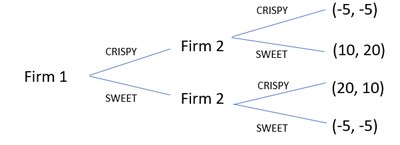
Example: In the Crispy-Sweet game, Firm 1 moves first, and Firm 2 observes and responds. The payoffs depend on the combination of choices.
Strategies in Sequential-Move Games
A strategy is a complete plan of action for every possible situation in a game. In sequential-move games, a player's strategy specifies what action to take at each decision point.
Firm 2's strategies are contingent on Firm 1's action (e.g., "If Firm 1 plays Crispy, I will play Sweet; if Firm 1 plays Sweet, I will play Crispy").
Firm 1, as the first mover, chooses between its available actions.
Backward Induction and Subgame Perfect Nash Equilibrium (SPNE)
To solve sequential-move games, economists use backward induction to find the Subgame Perfect Nash Equilibrium (SPNE). SPNE refines Nash Equilibrium by requiring that players' strategies constitute a Nash Equilibrium in every subgame of the original game.
Backward induction: Start from the end of the game tree and determine optimal actions at each decision node, working backward to the first move.
SPNE: A strategy profile where players' strategies are optimal at every stage of the game.
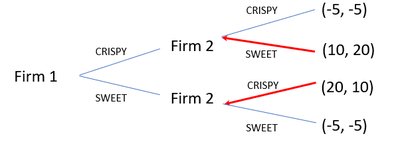
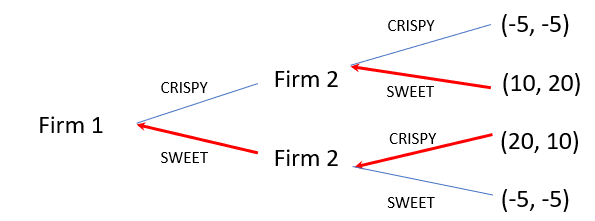
Example: In the Crispy-Sweet game, Firm 2's optimal strategy is to always play the opposite of Firm 1. Anticipating this, Firm 1 chooses Sweet, leading to the SPNE.
Payoff Differences and Order of Moves
The order in which players move can affect the equilibrium payoffs. If the follower moves first, the payoffs may change, demonstrating the importance of timing in sequential games.
First-mover advantage: The player who moves first can sometimes secure a higher payoff by anticipating the follower's best response.
However, not all sequential-move games guarantee a first-mover advantage (e.g., sequential rock-paper-scissors).
Practice Example: Battle of the Sexes (Sequential-Move Version)
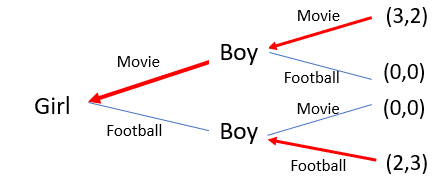
Consider a game where the girl moves first, and the boy follows. The payoffs are as follows:
Boy: Movie | Boy: Football | |
|---|---|---|
Girl: Movie | (3,2) | (0,0) |
Girl: Football | (0,0) | (2,3) |
Using backward induction, the boy will always follow the girl's choice, so the girl chooses "Movie" for a payoff of (3,2).
Duopoly Game: Sequential-Move Version (Stackelberg Game)
In a sequential-move duopoly (Stackelberg) game, Firm 1 moves first, and Firm 2 observes and responds. The payoffs for different strategies (L, M, H) are shown below:
Firm 2: L | Firm 2: M | Firm 2: H | |
|---|---|---|---|
Firm 1: L | (112,112) | (93,125) | (56,112) |
Firm 1: M | (125,93) | (100,100) | (50,75) |
Firm 1: H | (112,56) | (75,50) | (0,0) |
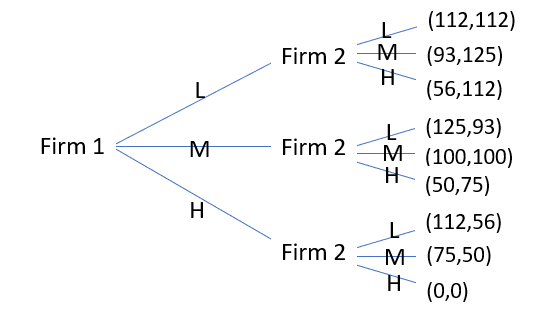
Backward induction reveals the SPNE: Firm 2 plays M in response to L or M, and L in response to H. Firm 1 chooses H, resulting in payoffs (112, 56).
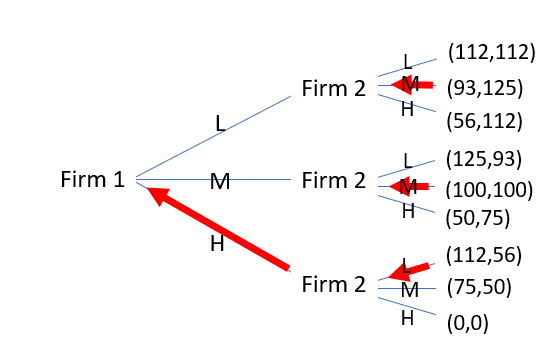
Variants: If Firm 2 moves first, the payoffs reverse, showing the first-mover advantage. In the simultaneous-move (Cournot) version, both firms play M.
Divide and Choose Game
This sequential-move game models fair division:
Player 1 (Cutter) divides a pie into two pieces: (x, 1-x).
Player 2 (Chooser) observes the division and selects one piece.
Payoffs correspond to the size of the piece each player receives.
Using backward induction, Player 2 will always choose the larger piece. Anticipating this, Player 1 divides the pie equally to maximize the minimum payoff.
Summary Table: Key Concepts in Sequential-Move Games
Concept | Definition | Example |
|---|---|---|
Dominant Strategy | Best action regardless of opponent's move | Choosing "Crispy" if always optimal |
Nash Equilibrium | Best response to others' strategies | Both firms choosing "M" in Cournot |
SPNE | Nash Equilibrium in every subgame | Backward induction in Stackelberg |
First-Mover Advantage | Benefit from moving first | Stackelberg leader's higher payoff |
Additional info: The Stackelberg and Cournot models are classic duopoly frameworks in microeconomics, illustrating the impact of timing and information on strategic outcomes.
