 Back
The Law of Supply: Marginal Opportunity Costs, Sunk Costs, and Changes in Supply
Study Guide - Smart Notes
 Tailored notes based on your materials, expanded with key definitions, examples, and context.
The Law of Supply
Introduction to Supply
The law of supply is a fundamental principle in microeconomics, describing how businesses respond to changes in price. It states that as the price of a product or service increases, the quantity supplied also increases, assuming all other factors remain constant. This relationship is driven by the need for businesses to cover their opportunity costs and maximize profits.
Supply: The willingness of businesses to produce a particular product or service because the price covers all opportunity costs.
Quantity Supplied: The actual amount businesses plan to supply at a given price.
Law of Supply: If the price of a product or service rises, quantity supplied increases.
Opportunity Costs and Marginal Costs
All costs in economics are considered opportunity costs, which represent the value of the next best alternative forgone. Marginal cost is the additional opportunity cost incurred when increasing the quantity supplied by one unit. Businesses must pay higher prices to obtain more inputs because opportunity costs change with circumstances.
Opportunity Cost: The value of the best alternative use of a resource.
Marginal Cost: The additional opportunity cost of increasing quantity supplied.
Marginal Opportunity Cost: The complete term for any cost relevant to a smart decision; all opportunity costs are marginal costs and vice versa.
Example: If a business must pay more to hire additional labor, the extra cost reflects the opportunity cost of the labor's next best use.

Sunk Costs and Decision Making
Sunk costs are past expenses that cannot be recovered and should not influence future choices. Smart, forward-looking decisions only consider additional benefits and opportunity costs, not sunk costs.
Sunk Cost: A cost that has already been incurred and cannot be reversed.
Sunk costs are not part of opportunity costs for future decisions.
Smart choices ignore sunk costs and focus on marginal costs and benefits.

Example: Bus Fare vs. Car Ride
Suppose you have paid your bus fare, and a friend offers you a ride. The paid fare is a sunk cost and should not influence your decision. Instead, compare the additional benefits and opportunity costs of staying on the bus versus taking the ride.
Ignore the paid fare when making your choice.
Consider only the additional benefits and opportunity costs of each option.


Marginal Opportunity Costs and Production Possibilities
Production Possibilities Frontier (PPF)
The Production Possibilities Frontier (PPF) illustrates the trade-offs between two goods that a business can produce, given limited resources. The slope of the PPF reflects the marginal opportunity cost of producing one good in terms of the other.
Inputs are not equally productive in all activities, leading to increasing marginal opportunity costs.
When inputs are equally productive, marginal opportunity costs are constant.
Combination | Piercings | Tattoos |
|---|---|---|
A | 15 | 0 |
B | 14 | 1 |
C | 12 | 2 |
D | 9 | 3 |
E | 5 | 4 |
F | 0 | 5 |
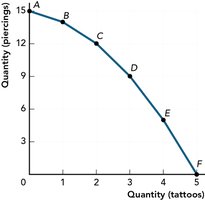
Marginal Opportunity Cost Table
The marginal opportunity cost of producing more tattoos is measured by the number of piercings given up.
Marginal Opportunity Cost of Additional Tattoos (piercings sets given up) | Quantity Supplied (tattoos) |
|---|---|
1 | 1 |
2 | 2 |
3 | 3 |
4 | 4 |
5 | 5 |

Supply Curves and Market Supply
Reading the Supply Curve
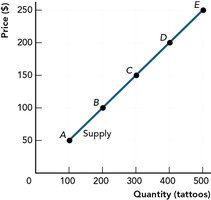
The supply curve shows the relationship between price and quantity supplied, holding other factors constant. There are two ways to interpret the supply curve:
As a supply curve: Read over-and-down from price to quantity supplied.
As a marginal cost curve: Read up-and-over from quantity supplied to price.
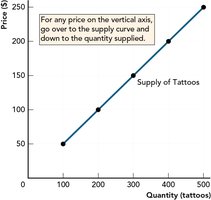
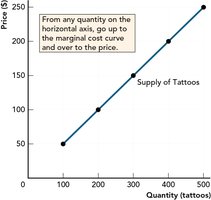
A marginal cost curve shows the minimum price businesses will accept that covers all marginal opportunity costs of production.
Market Supply
Market supply is the sum of supplies of all businesses willing to produce a particular product or service. The law of supply applies to both individual and market supply.
Market supply increases as price increases.
Market supply is represented by the horizontal sum of individual supply curves.
Price (marginal opportunity cost or minimum willing to accept per tattoo) | Quantity Supplied (tattoos) |
|---|---|
$50 | 1 |
$100 | 2 |
$150 | 3 |
$200 | 4 |
$250 | 5 |
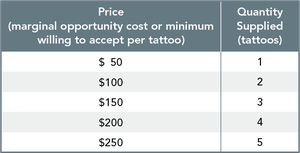
Changes in Supply vs. Changes in Quantity Supplied
Factors Changing Supply
Supply can change due to various influences on business decisions, such as technology, input prices, prices of related products, expected future prices, number of businesses, and environmental factors. An increase in supply shifts the supply curve rightward, while a decrease shifts it leftward.
Improvement in technology increases supply.
Environmental changes can help or hinder production.
Fall in input prices or prices of related products increases supply.
Increase in the number of businesses increases supply.
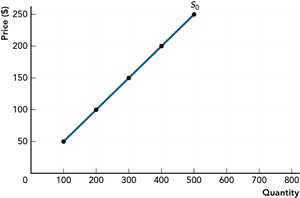
Price (marginal opportunity cost or minimum willing to accept per tattoo) | Quantity Supplied (before technology improvement) | Quantity Supplied (after technology improvement) |
|---|---|---|
$50 | 100 | 300 |
$100 | 200 | 400 |
$150 | 300 | 500 |
$200 | 400 | 600 |
$250 | 500 | 700 |
Change in Quantity Supplied
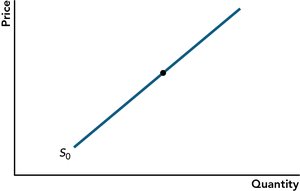
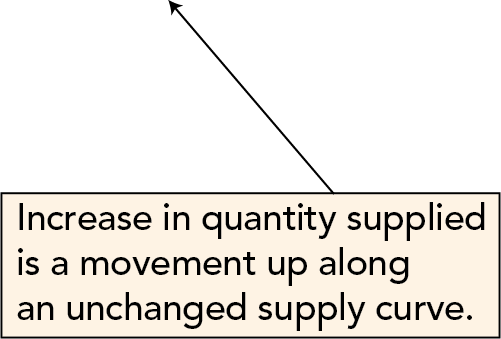
A change in quantity supplied is caused only by a change in price and is represented by movement along the supply curve. In contrast, a change in supply is caused by other factors and shifts the entire supply curve.
Increase in quantity supplied: Movement up along an unchanged supply curve.
Decrease in quantity supplied: Movement down along an unchanged supply curve.
Increase in supply: Rightward shift of the supply curve.
Decrease in supply: Leftward shift of the supply curve.
Summary Table: Law of Supply and Changes in Supply
Type of Change | Effect |
|---|---|
Change in Quantity Supplied | Movement along the supply curve (caused by price change) |
Change in Supply | Shift of the supply curve (caused by other factors) |
Key Takeaways: The law of supply explains how businesses respond to price changes by adjusting quantity supplied. Marginal opportunity costs are central to supply decisions, while sunk costs are irrelevant for future choices. Changes in supply are caused by factors other than price, leading to shifts in the supply curve.
