 Back
BackThe Production Process: The Behavior of Profit-Maximizing Firms
Study Guide - Smart Notes
 Tailored notes based on your materials, expanded with key definitions, examples, and context.
The Production Process: The Behavior of Profit-Maximizing Firms
Introduction to the Production Process
Firms are central to the economy, transforming inputs into outputs to meet market demand. Their primary objective is to maximize profits by making efficient production and cost decisions. Understanding the behavior of profit-maximizing firms is essential for analyzing market supply and the allocation of resources.
The Behavior of Profit-Maximizing Firms
Basic Decisions of Firms
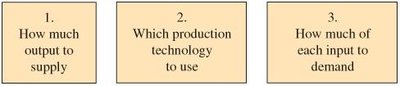
All firms must make three fundamental decisions to achieve profit maximization:
How much output to supply
Which production technology to use
How much of each input to demand
Profits and Economic Costs
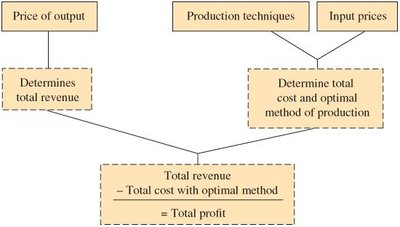
Profit is the difference between total revenue and total cost. In economics, profit typically refers to economic profit, which accounts for both explicit costs (direct, out-of-pocket payments) and implicit costs (opportunity costs of resources).
Total Revenue (TR): The total amount received from sales, calculated as price per unit times quantity sold.
Total Cost (TC): The sum of all costs incurred in production, including both fixed and variable costs.
Economic Profit:
Normal Rate of Return: The minimum profit necessary to keep a firm in operation, often equivalent to the return on risk-free investments.
Short-Run vs. Long-Run Decisions
The time horizon affects the flexibility of firms in adjusting their production:
Short Run: At least one input is fixed; firms cannot enter or exit the industry.
Long Run: All inputs are variable; firms can adjust their scale of operation and enter or exit the industry.
The Bases of Firm Decisions
To maximize profit, firms must consider:
Market Price of Output: Determines potential revenue.
Available Technology: Determines the input-output relationship.
Input Prices: Determines the cost of production.
The optimal method of production is the one that minimizes cost for a given level of output.
The Production Process
Production Technology
Production technology describes the quantitative relationship between inputs and outputs. Firms may use:
Labor-Intensive Technology: Relies more on human labor.
Capital-Intensive Technology: Relies more on machinery and equipment.
Production Functions: Total, Marginal, and Average Product
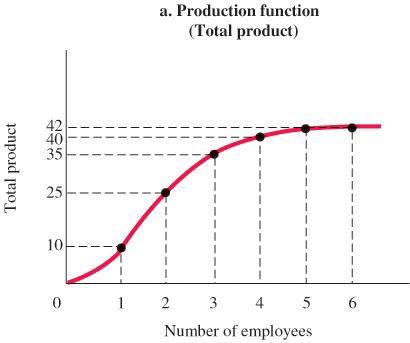
The production function (or total product function) expresses the relationship between the quantity of inputs used and the quantity of output produced.
Total Product (TP): Total output produced with a given amount of input.
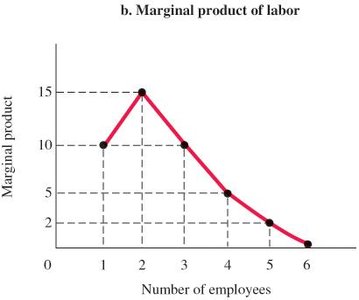
Marginal Product (MP): The additional output from using one more unit of input, holding other inputs constant.
Average Product (AP): Output per unit of input, calculated as
The Law of Diminishing Returns
The law of diminishing returns states that as additional units of a variable input are added to fixed inputs, the marginal product of the variable input eventually declines. This principle is fundamental in the short run and explains why increasing labor, for example, eventually leads to smaller increases in output.
Marginal Product vs. Average Product
If marginal product is above average product, the average rises.
If marginal product is below average product, the average falls.
Production with Two Variable Inputs
When both capital and labor are variable, they often act as complementary inputs. Increasing capital can raise the productivity of labor, and vice versa. This relationship is crucial for understanding productivity growth at the firm and national levels.
Choice of Technology
Cost-Minimizing Technology
Firms choose among alternative production technologies based on input prices and available techniques. The goal is to minimize the cost of producing a given output.
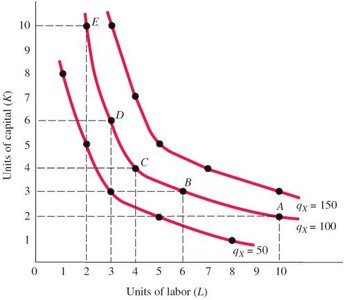
Technology | Units of Capital (K) | Units of Labor (L) |
|---|---|---|
A | 2 | 10 |
B | 3 | 6 |
C | 4 | 4 |
D | 6 | 3 |
E | 10 | 2 |
Input prices affect the cost-minimizing choice. For example, if labor is expensive relative to capital, firms will prefer more capital-intensive technologies.
Isoquants and Isocosts (Appendix)
Isoquants
An isoquant is a curve showing all combinations of capital and labor that produce the same level of output. Isoquants are analogous to indifference curves in consumer theory.
Isocost Lines
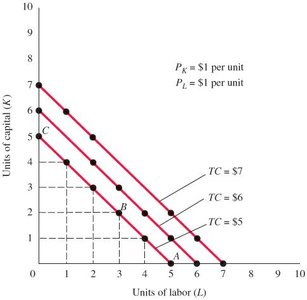
An isocost line shows all combinations of capital and labor that can be purchased for a given total cost. The equation for an isocost line is:
where is total cost, is the price of capital, is the quantity of capital, is the price of labor, and is the quantity of labor.
Cost Minimization with Isoquants and Isocosts
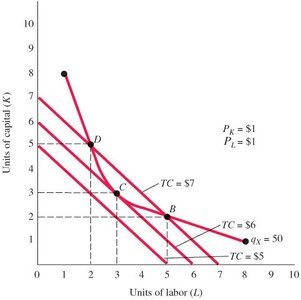
The cost-minimizing combination of inputs occurs where an isoquant is tangent to an isocost line. At this point, the marginal rate of technical substitution (MRTS) equals the ratio of input prices:
Cost Curves
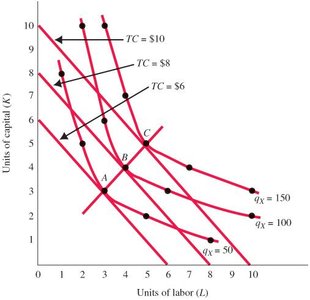
By plotting the minimum cost of producing each output level, we derive the firm's cost curve, which is fundamental for supply analysis in competitive markets.
Key Terms and Concepts
Average Product
Capital-Intensive Technology
Economic Profit
Firm
Labor-Intensive Technology
Law of Diminishing Returns
Long Run
Marginal Product
Normal Rate of Return
Optimal Method of Production
Production
Production Function
Production Technology
Profit
Short Run
Total Cost
Total Revenue
Isoquant
Isocost Line
Marginal Rate of Technical Substitution
Key Equations
Profit:
Average Product:
Isocost Line:
Cost-Minimizing Condition:
Additional info: This summary expands on the provided slides and tables with academic context, definitions, and formulas to ensure a comprehensive, self-contained study guide for microeconomics students.
