 Back
BackTrade-offs, Comparative Advantage, and the Market System: Microeconomics Study Notes
Study Guide - Smart Notes
 Tailored notes based on your materials, expanded with key definitions, examples, and context.
Unit 2: Trade-offs, Comparative Advantage, and the Market System
Scarcity and Trade-offs
Scarcity is a fundamental concept in economics, referring to the situation where unlimited wants exceed the limited resources available to fulfill those wants. This condition necessitates trade-offs, as individuals and firms must decide how to allocate their resources most effectively.
Scarcity: Requires making choices about resource allocation.
Trade: Occurs in markets as households and firms make decisions to maximize their well-being.
Markets: Facilitate the exchange of goods and services, resulting from the decisions of millions of participants worldwide.
Production Possibilities Frontier (PPF) and Opportunity Costs
The Production Possibilities Frontier (PPF) is a curve that illustrates the maximum attainable combinations of two goods that can be produced with available resources and current technology. It is a graphical representation of trade-offs and opportunity costs.
PPF: Shows efficient, inefficient, and unattainable production combinations.
Opportunity Cost: The value of the next best alternative foregone when making a choice.
Efficiency: Points on the PPF represent efficient use of resources; points inside are inefficient, and points outside are unattainable.
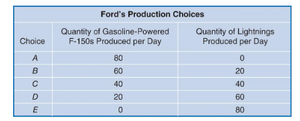
Example: Ford's production choices between gasoline-powered F-150s and F-150 Lightnings demonstrate the concept of trade-offs and opportunity costs.
Choice | Quantity of Gasoline-Powered F-150s Produced per Day | Quantity of Lightnings Produced per Day |
|---|---|---|
A | 80 | 0 |
B | 60 | 20 |
C | 40 | 40 |
D | 20 | 60 |
E | 0 | 80 |
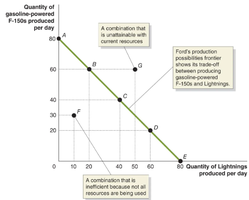
Graphical Representation of the PPF
The PPF graph visually demonstrates the trade-off between producing gasoline-powered F-150s and Lightnings. Efficient points (A-E) are on the frontier, while points inside (F) are inefficient and points outside (G) are unattainable.
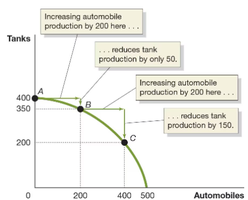
Increasing Marginal Opportunity Costs
As production shifts from one good to another along the PPF, the opportunity cost increases. This is due to resources being better suited for one activity than another, leading to increasing marginal opportunity costs.
Marginal Opportunity Cost: The additional cost of producing one more unit of a good, measured in terms of the forgone production of another good.
Bowed-Out PPF: Indicates increasing opportunity costs as more resources are devoted to an activity.
Economic Growth and Shifts in the PPF
Economic growth occurs when an economy's ability to produce goods and services increases, often due to increases in labor, capital, or technological advancements. This results in an outward shift of the PPF.
Capital Stock: The total amount of machinery and physical capital available.
Technological Change: Allows more goods to be produced with the same resources.
Economic Growth: Outward shifts in the PPF raise the standard of living.
Comparative Advantage and Trade
Trade enables individuals, firms, and countries to specialize in the production of goods and services for which they have a comparative advantage, leading to increased overall production and consumption.
Trade: The act of buying and selling in markets.
Specialization: Concentrating on the production of goods or services where one has a comparative advantage.
Gains from Trade: Both parties can consume more than they could without trade.
Example: Apple and Cherry Picking
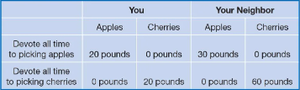
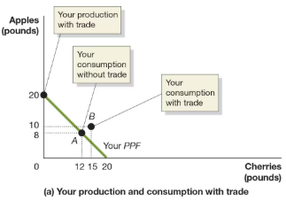
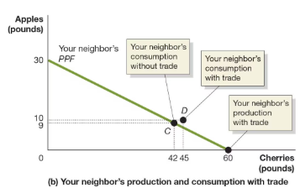
The table below shows the production possibilities for you and your neighbor when devoting all time to picking apples or cherries.
You | Your Neighbor | |||
|---|---|---|---|---|
Apples | Cherries | Apples | Cherries | |
Devote all time to picking apples | 20 pounds | 0 pounds | 30 pounds | 0 pounds |
Devote all time to picking cherries | 0 pounds | 20 pounds | 0 pounds | 60 pounds |
Graphical Representation of Trade
PPF graphs for you and your neighbor show how specialization and trade allow both parties to consume more than they could produce alone.
Absolute Advantage vs Comparative Advantage
Absolute advantage refers to the ability to produce more of a good or service than competitors using the same resources. Comparative advantage is the ability to produce a good or service at a lower opportunity cost than competitors.
Absolute Advantage: Producing more with the same resources.
Comparative Advantage: Producing at a lower opportunity cost.
Basis for Trade: Comparative advantage, not absolute advantage, determines the gains from trade.
The Market System
Markets are institutions where buyers and sellers come together to exchange goods and services. They answer three fundamental questions: what to produce, how to produce, and who receives the goods and services.
Product Markets: Where goods and services are bought and sold.
Factor Markets: Where inputs (labor, capital, natural resources, entrepreneurship) are bought and sold.
Households: Demand goods and supply factors of production.
Firms: Supply goods and demand factors of production.
The Circular Flow of Income
The circular-flow diagram illustrates how households and firms interact in product and factor markets, showing the flow of goods, services, and funds.
Households: Supply labor and other factors, receive income, and purchase goods and services.
Firms: Produce goods and services, hire factors of production, and receive revenue from sales.

The Gains from Free Markets
Free markets have few government restrictions, allowing for efficient allocation of resources and higher standards of living. Adam Smith advocated for free markets, arguing that restrictions reduce income and wealth.
Free Market: Minimal government intervention.
Guild System: Historical system with government restrictions, limiting competition.
Market Mechanism: Prices adjust to reflect consumer preferences, guiding firms' production decisions.
How the Market Mobilizes Knowledge
Competition in markets mobilizes knowledge and incentivizes innovation, leading to better economic outcomes than central planning.
Competition: Drives firms to innovate and respond to consumer needs.
Knowledge Mobilization: Markets efficiently allocate resources based on dispersed information.
The Role of the Entrepreneur in the Market System
Entrepreneurs are essential to the market system, bringing together factors of production to create new goods and services and drive technological progress.
Entrepreneur: Operates a business, combines resources, and innovates.
Opportunity Identification: Successful entrepreneurs find new ways to meet consumer needs.
The Legal Basis of a Successful Market System
Property rights and legal protections are necessary for markets to function efficiently. Intellectual property rights, such as patents, encourage innovation by granting exclusive rights to inventors.
Property Rights: Guarantee exclusive use and transfer of property.
Intellectual Property: Protected by patents, copyrights, and trademarks.
Legal Protections: Encourage investment and risk-taking.
Key Equations
Opportunity Cost:
PPF Slope:
Additional info: Academic context and examples have been expanded for clarity and completeness.
