 Back
Trade-offs, Comparative Advantage, and the Market System: Chapter 2 Study Notes
Study Guide - Smart Notes
 Tailored notes based on your materials, expanded with key definitions, examples, and context.
Chapter 2: Trade-offs, Comparative Advantage, and the Market System
2.1 Production Possibilities Frontiers and Opportunity Costs
The Production Possibilities Frontier (PPF) is a fundamental model in microeconomics that illustrates the trade-offs and opportunity costs faced by producers when allocating scarce resources between two goods. The PPF shows the maximum attainable combinations of two products that can be produced with available resources and technology.
Scarcity: The condition where unlimited wants exceed the limited resources available. Scarcity forces individuals, firms, and governments to make choices, leading to trade-offs.
Trade-off: Choosing more of one good or activity means having less of another due to limited resources.
Opportunity Cost: The highest-valued alternative that must be given up to engage in an activity. For example, if Ford produces more electric vehicles, it must produce fewer gasoline-powered trucks.
Efficiency: Points on the PPF are efficient (all resources are fully utilized), points inside are inefficient, and points outside are unattainable with current resources.
Positive vs. Normative Analysis: The PPF is a positive tool, describing what is possible, not what should be.
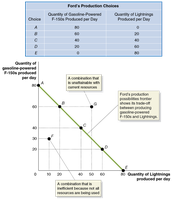
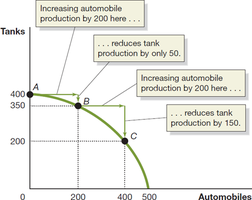
Increasing Marginal Opportunity Costs: The PPF is often bowed outward, reflecting that as production of one good increases, the opportunity cost of producing additional units rises. This occurs because resources are not equally suited to all tasks.
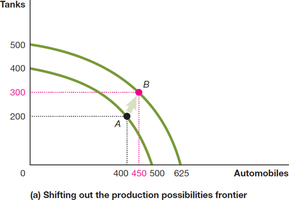
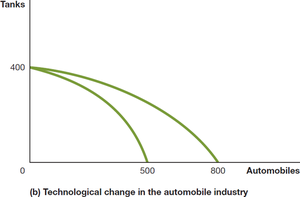
Economic Growth: When an economy's resources increase or technology improves, the PPF shifts outward, allowing more of both goods to be produced. Growth can be general (all goods) or specific (one industry).
Example: Allocating study time between two exams (Economics and Accounting) also creates a PPF, typically bowed outward, reflecting increasing opportunity costs as more time is devoted to one subject over the other.
2.2 Comparative Advantage and Trade
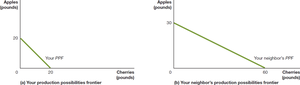
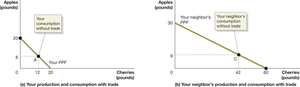
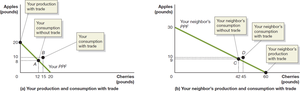
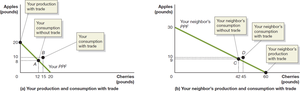
Comparative advantage is the foundation of trade. It refers to the ability of an individual, firm, or country to produce a good or service at a lower opportunity cost than competitors. Even if one party has an absolute advantage (can produce more of both goods), both can benefit from trade by specializing according to comparative advantage.
Specialization: Each party should specialize in the good for which they have a comparative advantage and trade for the other good.
Gains from Trade: Specialization and exchange allow both parties to consume beyond their individual PPFs.
Key Definitions:
Absolute Advantage: The ability to produce more of a good or service than competitors using the same amount of resources.
Comparative Advantage: The ability to produce a good or service at a lower opportunity cost than competitors.
Application: Division of labor in households (e.g., cooking and laundry) can be optimized using comparative advantage, even if one person is better at both tasks.
2.3 The Market System
The market system is the institutional arrangement through which buyers and sellers interact to exchange goods and services. It relies on the decentralized decisions of households and firms, coordinated by prices and markets.
Market: A group of buyers and sellers of a good or service and the institution or arrangement by which they come together to trade.
Households: Provide factors of production (labor, capital, natural resources, entrepreneurial ability).
Firms: Purchase factors of production from households and use them to produce goods and services.
Factor Market: Where factors of production are bought and sold.
Product Market: Where goods and services are bought and sold.

The Circular-Flow Diagram: Illustrates the flow of resources, goods and services, and money in an economy. Households supply factors of production to firms, and firms supply goods and services to households. Money flows in the opposite direction.

Free Markets and the Market Mechanism: In a free market, prices are determined by supply and demand with minimal government intervention. The market mechanism, described by Adam Smith as the "invisible hand," coordinates individual self-interest to achieve collective outcomes.
Flexible prices signal where resources are most valued.
Entrepreneurs play a key role in innovation and economic growth.
Knowledge and Coordination: Markets efficiently process and mobilize both general and local knowledge, allowing rapid adaptation to changing conditions.

Legal Foundations of Markets: For markets to function well, governments must protect property rights and enforce contracts. An independent legal system is essential for economic transactions and investment.
Property Rights: The rights to use, buy, or sell property.
Enforcement of Contracts: Ensures that agreements are honored, facilitating trade and investment.
Economic Systems: Socialism vs. Capitalism
Socialism: Involves significant government control or ownership of resources and industries. Modern social democracies advocate for a large government role in sectors like health care and education, but not full state ownership as in Marxist socialism.
Capitalism: Relies on private ownership and free markets to allocate resources.
Summary Table: Gains from Trade
Scenario | Your Consumption (Apples, Cherries) | Neighbor's Consumption (Apples, Cherries) |
|---|---|---|
Without Trade | 8, 12 | 9, 42 |
With Trade | 10, 15 | 10, 45 |
Key Equations:
Opportunity Cost (of Good X):
