 Back
BackWhere Prices Come From: The Interaction of Demand and Supply
Study Guide - Smart Notes
 Tailored notes based on your materials, expanded with key definitions, examples, and context.
Chapter 3: Where Prices Come From – The Interaction of Demand and Supply
Introduction
This chapter explores how prices are determined in markets through the interaction of demand and supply. It introduces the model of a perfectly competitive market and examines the factors that shift demand and supply, leading to changes in equilibrium price and quantity.
The Demand Side of the Market
Market Demand and Its Determinants
Market demand refers to the total demand by all consumers for a given good or service. The relationship between the price of a product and the quantity demanded is captured by the demand schedule and the demand curve.
Demand Schedule: A table showing the relationship between price and quantity demanded.
Demand Curve: A graphical representation of the demand schedule, typically downward sloping, indicating that as price falls, quantity demanded increases.
Quantity Demanded: The amount of a good consumers are willing and able to purchase at a given price.
Law of Demand: Holding all else constant, when the price of a product falls, the quantity demanded increases, and vice versa.
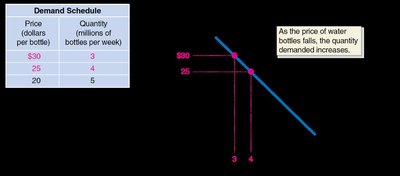
Explaining the Law of Demand
Substitution Effect: When the price of a good falls, consumers substitute toward the cheaper good.
Income Effect: A lower price increases consumers' purchasing power, allowing them to buy more.
Ceteris Paribus in Demand Analysis
Ceteris paribus means "all else equal." When analyzing the relationship between price and quantity demanded, all other variables are held constant.
Shifts in the Demand Curve
A change in a variable other than price causes the entire demand curve to shift:
Increase in Demand: Demand curve shifts right.
Decrease in Demand: Demand curve shifts left.

Variables That Shift Market Demand
Income: Increases demand for normal goods, decreases for inferior goods.
Prices of Related Goods: Substitutes (increase in price of one increases demand for the other); Complements (increase in price of one decreases demand for the other).
Tastes: Changes in consumer preferences can increase or decrease demand.
Population and Demographics: More buyers increase demand.
Expected Future Prices: If prices are expected to rise, current demand increases.
Natural Disasters and Pandemics: Can temporarily disrupt demand for certain goods.
Normal and Inferior Goods
Normal Good: Demand increases as income rises (e.g., new clothes, restaurant meals).
Inferior Good: Demand increases as income falls (e.g., instant noodles, second-hand clothes).
Substitutes and Complements
Substitutes: Goods used for the same purpose (e.g., Big Mac and Whopper).
Complements: Goods used together (e.g., left and right shoes).
Change in Demand vs. Change in Quantity Demanded
Change in Quantity Demanded: Movement along the demand curve due to a price change.
Change in Demand: Shift of the entire demand curve due to other factors.

The Supply Side of the Market
Market Supply and Its Determinants
Market supply refers to the total amount of a good or service that firms are willing and able to sell at various prices. The supply schedule and supply curve illustrate this relationship.
Supply Schedule: Table showing the relationship between price and quantity supplied.
Supply Curve: Graph showing the relationship between price and quantity supplied, typically upward sloping.
Quantity Supplied: The amount a firm is willing and able to supply at a given price.
Law of Supply: Holding all else constant, increases in price cause increases in quantity supplied, and vice versa.

Shifts in the Supply Curve
A change in a variable other than price causes the entire supply curve to shift:
Increase in Supply: Supply curve shifts right.
Decrease in Supply: Supply curve shifts left.

Variables That Shift Market Supply
Prices of Inputs: Higher input prices decrease supply; lower input prices increase supply.
Technological Change: Improvements increase supply; negative changes decrease supply.
Prices of Related Goods in Production: Substitutes in production (e.g., corn vs. soybeans); complements in production (e.g., beef and leather).
Number of Firms: More firms increase supply; fewer firms decrease supply.
Expected Future Prices: If firms expect higher future prices, they may decrease current supply.
Natural Disasters and Pandemics: Disruptions decrease supply.
Change in Supply vs. Change in Quantity Supplied
Change in Quantity Supplied: Movement along the supply curve due to a price change.
Change in Supply: Shift of the entire supply curve due to other factors.
Market Equilibrium: Putting Demand and Supply Together
Market Equilibrium
Market equilibrium occurs where the quantity demanded equals the quantity supplied. The corresponding price is the equilibrium price, and the quantity is the equilibrium quantity.
Competitive Market Equilibrium: Occurs in markets with many buyers and sellers, where no single agent can dictate price.
Surpluses and Shortages
Surplus: Quantity supplied exceeds quantity demanded at a given price; leads to downward pressure on price.
Shortage: Quantity demanded exceeds quantity supplied at a given price; leads to upward pressure on price.
The Effect of Demand and Supply Shifts on Equilibrium
Predicting Changes in Price and Quantity
Shifts in demand and/or supply curves lead to changes in equilibrium price and quantity. The direction of these changes depends on which curve shifts and by how much.
Supply Curve Unchanged | Supply Curve Shifts Right | Supply Curve Shifts Left | |
|---|---|---|---|
Demand Curve Unchanged | Q unchanged P unchanged | Q increases P decreases | Q decreases P increases |
Demand Curve Shifts Right | Q increases P increases | Q increases P increases, decreases, or unchanged | Q increases, decreases, or unchanged P increases |
Demand Curve Shifts Left | Q decreases P decreases | Q increases, decreases, or unchanged P decreases | Q decreases P increases, decreases, or unchanged |
Simultaneous Shifts
If both demand and supply shift, the effect on equilibrium price may be ambiguous without more information, but the effect on equilibrium quantity can often be predicted.
Movements Along vs. Shifts of Curves
A movement along a curve is caused by a change in the good's own price.
A shift of the curve is caused by changes in other determinants (income, tastes, input prices, etc.).
Key Formulas
Demand Function (general form):
Supply Function (general form):
Equilibrium Condition:
Examples and Applications
Reusable Water Bottles: Used as a case study throughout to illustrate demand and supply shifts, equilibrium, and the effects of changing tastes, demographics, and input prices.
Used Cars Market (2020): Supply shortages and increased demand led to higher prices for used cars.
Additional info: This summary covers the core concepts of demand and supply, their determinants, and the process of market equilibrium, as well as the effects of shifts in demand and supply on equilibrium price and quantity. It is suitable for exam preparation in introductory microeconomics.
