Skip to main content
Nutrition
My Course
Learn
Exam Prep
AI Tutor
Study Guides
Flashcards
Try the app
My Course
Learn
Exam Prep
AI Tutor
Study Guides
Flashcards
Try the app
Back
Accessory Organs definitions
You can tap to flip the card.
Liver
You can tap to flip the card.
👆
Liver
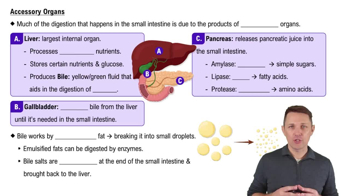
Largest internal organ responsible for processing absorbed nutrients, storing glucose, and producing bile for fat digestion.
Track progress
Control buttons has been changed to "navigation" mode.
1/15
Related flashcards
Related practice
Recommended videos
Accessory Organs quiz
Accessory Organs
15 Terms
Accessory Organs exam
Accessory Organs
26 Terms
Accessory Organs
3. The Human Body & Digestion
10 problems
Topic
Nutrient Absorption and Transport
3. The Human Body & Digestion
10 problems
Topic
3. The Human Body & Digestion
7 topics
15 problems
Chapter
02:18
Accessory Organs Example 1
308
views
4
rank
04:54
Accessory Organs
375
views
7
rank
Terms in this set (15)
Hide definitions
Liver
Largest internal organ responsible for processing absorbed nutrients, storing glucose, and producing bile for fat digestion.
Gallbladder
Small organ beneath the liver that stores bile until it is needed in the small intestine for fat emulsification.
Pancreas
Feather-shaped organ releasing pancreatic juice containing enzymes and bicarbonate into the small intestine.
Bile
Yellow-green fluid produced by the liver that emulsifies fats, enabling digestive enzymes to access and break them down.
Bile Salts
Active components of bile that emulsify fats and are reabsorbed in the small intestine for recycling by the liver.
Pancreatic Juice
Secretion containing bicarbonate and digestive enzymes, neutralizing stomach acid and aiding macronutrient breakdown.
Bicarbonate
Substance in pancreatic juice that neutralizes acidic chyme, raising pH for safe and effective digestion in the small intestine.
Pancreatic Amylase
Enzyme in pancreatic juice that breaks down starches and carbohydrates into simple sugars for absorption.
Pancreatic Lipase
Enzyme in pancreatic juice that digests fats into fatty acids, facilitating their absorption in the small intestine.
Pancreatic Protease
Enzyme in pancreatic juice that breaks down proteins into amino acids for absorption in the small intestine.
Duodenum
First section of the small intestine where chyme mixes with secretions from accessory organs for digestion.
Emulsification
Process by which large fat droplets are broken into smaller ones, increasing surface area for enzyme action.
Chyme
Partially digested, acidic food mixture entering the small intestine from the stomach for further digestion.
Absorption
Process in the small intestine where nutrients and bile salts are taken up into the bloodstream for use or recycling.
Macronutrients
Nutritional components such as carbohydrates, fats, and proteins that require enzymatic breakdown for absorption.
 BackBack
 02:18
02:18