Skip to main content
Nutrition
My Course
Learn
Exam Prep
AI Tutor
Study Guides
Flashcards
Try the app
My Course
Learn
Exam Prep
AI Tutor
Study Guides
Flashcards
Try the app
Back
Cardiovascular Disease quiz
1 student found this helpful
You can tap to flip the card.
What does the abbreviation CVD stand for?
You can tap to flip the card.
👆
What does the abbreviation CVD stand for?
CVD stands for cardiovascular disease, which refers to any abnormal condition involving the heart and blood vessels.
Track progress
Control buttons has been changed to "navigation" mode.
1/15
Related flashcards
Related practice
Recommended videos
Cardiovascular Disease definitions
Cardiovascular Disease
15 Terms
Cardiovascular Disease exam
Cardiovascular Disease
30 Terms
Cardiovascular Disease
5. Lipids
10 problems
Topic
Dietary Guidelines for Lipids
5. Lipids
10 problems
Topic
5. Lipids
6 topics
15 problems
Chapter
Guided course
02:35
Introduction to Cardiovascular Disease
249
views
Guided course
05:21
Abnormal Levels of Blood Lipids Contribute to CVD
267
views
1
rank
Guided course
04:39
Cardiovascular Disease Example 1
230
views
3
rank
Terms in this set (15)
Hide definitions
What does the abbreviation CVD stand for?
CVD stands for cardiovascular disease, which refers to any abnormal condition involving the heart and blood vessels.
Name two major risk conditions that often lead to cardiovascular disease.
Atherosclerosis and hypertension are two major risk conditions that often lead to cardiovascular disease.
What is atherosclerosis?
Atherosclerosis is the buildup of fatty plaques in the arteries, which narrows and hardens them, impairing blood flow.
How does hypertension contribute to cardiovascular disease?
Hypertension, or consistently high blood pressure, increases the risk of health problems and cardiovascular diseases.
List three risk factors for cardiovascular disease that are within your control.
Obesity, smoking, and unhealthy diet are risk factors for cardiovascular disease that are within your control.
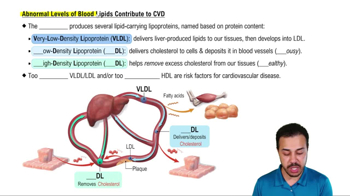
What are lipoproteins and where are they produced?
Lipoproteins are lipid-carrying molecules produced by the liver.
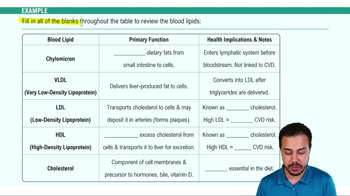
What is the main function of very low density lipoproteins (VLDL)?
VLDL delivers liver-produced lipids, including fatty acids, to tissues such as skeletal muscle and adipose tissue.
How does VLDL become LDL in the body?
As VLDL delivers fatty acids to tissues, it loses lipid content and its protein content increases, eventually becoming LDL.
What is the primary role of low density lipoprotein (LDL)?
LDL delivers cholesterol to cells throughout the body.
Why is LDL often referred to as 'bad cholesterol'?
LDL is called 'bad cholesterol' because high levels can lead to cholesterol deposits in arteries, forming plaques and increasing CVD risk.
What is the function of high density lipoprotein (HDL)?
HDL removes excess cholesterol from tissues and returns it to the liver for disposal.
Why is HDL considered 'good cholesterol'?
HDL is considered 'good cholesterol' because it helps prevent plaque formation by removing excess cholesterol from the bloodstream.
What happens to cholesterol removed by HDL?
Cholesterol removed by HDL is returned to the liver, where it can be used to produce bile and eventually excreted in stools.
Which blood lipid levels are considered risk factors for cardiovascular disease?
High levels of VLDL and LDL, and low levels of HDL, are risk factors for cardiovascular disease.
What percentage of deaths in the United States are attributed to cardiovascular diseases?
Cardiovascular diseases account for more than 30% of deaths in the United States.
 BackBack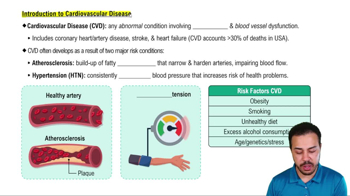
 02:35
02:35