Skip to main content
Nutrition
My Course
Learn
Exam Prep
AI Tutor
Study Guides
Flashcards
Try the app
My Course
Learn
Exam Prep
AI Tutor
Study Guides
Flashcards
Try the app
Back
Dietary Guidelines for Lipids definitions
You can tap to flip the card.
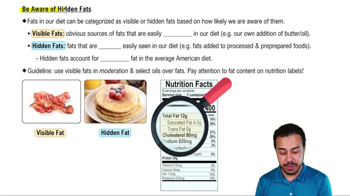
Visible Fats
You can tap to flip the card.
👆
Visible Fats
Obvious sources of dietary fat easily seen in foods, such as butter, oil, and bacon, often added during cooking or present in recognizable form.
Track progress
Control buttons has been changed to "navigation" mode.
1/15
Related flashcards
Related practice
Recommended videos
Dietary Guidelines for Lipids quiz
Dietary Guidelines for Lipids
15 Terms
Dietary Guidelines for Lipids exam
Dietary Guidelines for Lipids
29 Terms
Dietary Guidelines for Lipids quiz #1
Dietary Guidelines for Lipids
10 Terms
Dietary Guidelines for Lipids
5. Lipids
10 problems
Topic
Cardiovascular Disease
5. Lipids
10 problems
Topic
5. Lipids
6 topics
15 problems
Chapter
Guided course
04:37
Recommended Dietary Guidelines: Lipids
249
views
2
rank
Guided course
02:31
Be Aware of Hidden Fats
272
views
2
rank
Guided course
02:04
Dietary Guidelines for Lipids Example 2
213
views
1
rank
Terms in this set (15)
Hide definitions
Visible Fats
Obvious sources of dietary fat easily seen in foods, such as butter, oil, and bacon, often added during cooking or present in recognizable form.
Hidden Fats
Fats not easily seen or recognized in foods, commonly found in processed or pre-prepared items, often contributing most to total fat intake.
Saturated Fats
Solid fats at room temperature, often found in animal products, linked to increased risk of cardiovascular diseases when overconsumed.
Unsaturated Fats
Liquid fats at room temperature, typically from plant sources, recommended as healthier alternatives to saturated fats.
Trans Fats
Artificially created fats found in processed foods, strongly associated with increased cardiovascular disease risk.
Cholesterol
A lipid produced by the liver, not essential in the diet, with intake often limited as a precaution due to its association with saturated fats.
Acceptable Macronutrient Distribution Range
Guideline recommending that 20-35% of daily energy intake should come from fats for optimal health.
Essential Fatty Acids
Fats that must be obtained from the diet, including omega-3 and omega-6 types, necessary for various bodily functions.
Alpha-Linolenic Acid
An essential omega-3 fatty acid required in small daily amounts, found in plant sources like nuts and seeds.
Linoleic Acid
An essential omega-6 fatty acid, needed in the diet, commonly found in plant oils and nuts.
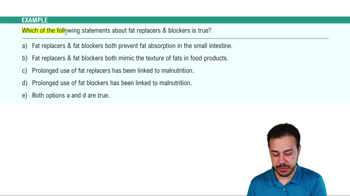
Fat Replacers
Ingredients designed to mimic fat's texture and function, used to lower fat and calorie content in foods.
Fat Blockers
Substances that inhibit fat absorption in the digestive tract, potentially leading to reduced calorie intake and possible malnutrition.
Fat Soluble Vitamins
Nutrients such as vitamins A, D, E, and K, which require dietary fat for absorption and can be affected by fat blockers.
Nutrient Dense Lipids
Fats that provide essential nutrients along with energy, often found in whole plant foods, nuts, seeds, and fish.
Dietary Guidelines
Recommendations for optimal fat intake, emphasizing moderation, variety, and the replacement of unhealthy fats with healthier options.
 BackBack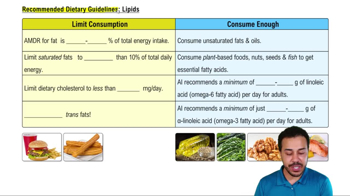
 04:37
04:37