Skip to main content
Nutrition
My Course
Learn
Exam Prep
AI Tutor
Study Guides
Flashcards
Try the app
My Course
Learn
Exam Prep
AI Tutor
Study Guides
Flashcards
Try the app
Back
Dietary Guidelines for Vitamins definitions
You can tap to flip the card.
Micronutrients
You can tap to flip the card.
👆
Micronutrients
Nutrients required in small amounts that are vital for health and include all vitamins essential for bodily functions.
Track progress
Control buttons has been changed to "navigation" mode.
1/15
Related flashcards
Related practice
Recommended videos
Dietary Guidelines for Vitamins quiz
Dietary Guidelines for Vitamins
15 Terms
Dietary Guidelines for Vitamins exam
Dietary Guidelines for Vitamins
30 Terms
Dietary Guidelines for Vitamins
7. Vitamins
10 problems
Topic
Other Vitamin-Like Nutrients
7. Vitamins
10 problems
Topic
7. Vitamins
5 topics
15 problems
Chapter
Guided course
03:11
Dietary Guideline for Vitamins
249
views
3
rank
Guided course
01:59
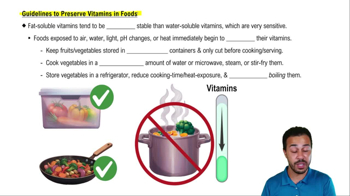
Guidelines to Preserve Vitamins in Foods
201
views
2
rank
Guided course
01:58
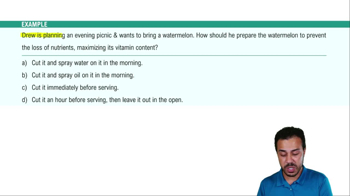
Dietary Guidelines for Vitamins Example 1
177
views
2
rank
Terms in this set (15)
Hide definitions
Micronutrients
Nutrients required in small amounts that are vital for health and include all vitamins essential for bodily functions.
Recommended Dietary Allowance
Daily intake level considered sufficient to meet the nutrient needs of nearly all healthy individuals in a group.
Adequate Intake
Estimated daily nutrient intake assumed to ensure nutritional adequacy when an RDA cannot be determined.
Tolerable Upper Intake Level
Maximum daily nutrient amount unlikely to cause adverse health effects for most people.
Nutrient-Dense Foods
Foods providing substantial vitamins and minerals with relatively few calories, supporting optimal health.
Fortified Foods
Products with added nutrients to address dietary gaps, often used when certain foods are avoided.
Fat Soluble Vitamins
Vitamins stored in body tissues, more stable, and present higher toxicity risk when consumed in excess.
Water Soluble Vitamins
Vitamins sensitive to heat, light, and water, not stored in the body, and excess amounts are excreted in urine.
Vitamin Preservation
Practices such as minimizing exposure to air, water, heat, and light to retain vitamin content in foods.
Supplementation
Use of concentrated nutrient products, often necessary for specific populations but risky if overused.
Toxicity
Adverse health effects resulting from excessive intake of certain vitamins, especially fat soluble types.
Processed Foods
Items often containing added sugars, artificial ingredients, and fewer beneficial nutrients compared to whole foods.
Artificial Additives
Substances such as colors, flavors, and preservatives added to foods, often found in processed or fortified products.
Neural Tube Defects
Birth abnormalities linked to insufficient intake of certain vitamins, notably folate, during pregnancy.
Deficiency
Condition arising from insufficient intake of essential vitamins, leading to health complications.
 BackBack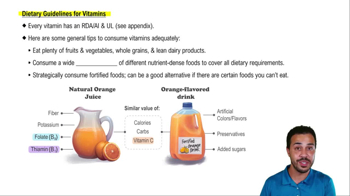
 03:11
03:11