Skip to main content
Nutrition
My Course
Learn
Exam Prep
AI Tutor
Study Guides
Flashcards
Try the app
My Course
Learn
Exam Prep
AI Tutor
Study Guides
Flashcards
Try the app
Back
Digestion of Fats definitions
You can tap to flip the card.
Triglyceride
You can tap to flip the card.
👆
Triglyceride
A lipid molecule composed of glycerol bound to three fatty acids, serving as the main form of dietary and stored fat in the body.
Track progress
Control buttons has been changed to "navigation" mode.
1/15
Related flashcards
Related practice
Recommended videos
Digestion of Fats quiz
Digestion of Fats
15 Terms
Digestion of Fats exam
Digestion of Fats
29 Terms
Digestion of Fats
5. Lipids
10 problems
Topic
Dietary Guidelines for Lipids
5. Lipids
10 problems
Topic
5. Lipids
6 topics
15 problems
Chapter
Guided course
03:14
Released Fatty Acids Have 3 Primary Fates
260
views
3
rank
Guided course
03:42
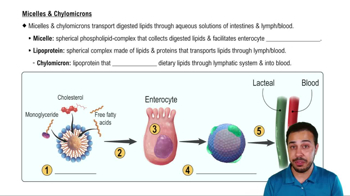
Micelles & Chylomicrons
556
views
2
rank
Guided course
04:52
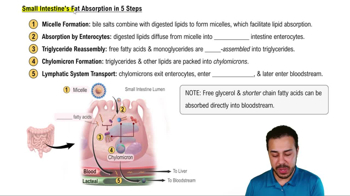
Small Intestine's Fat Absorption in 5 Steps
324
views
4
rank
Terms in this set (15)
Hide definitions
Triglyceride
A lipid molecule composed of glycerol bound to three fatty acids, serving as the main form of dietary and stored fat in the body.
Monoglyceride
A lipid molecule consisting of glycerol attached to a single fatty acid, produced during fat digestion.
Free Fatty Acid
A hydrocarbon chain released from triglycerides during digestion, available for absorption or energy use.
Lipase
An enzyme that catalyzes the breakdown of triglycerides into free fatty acids and monoglycerides.
Lingual Lipase
An enzyme secreted by the tongue that initiates fat digestion in the mouth.
Gastric Lipase
An enzyme produced in the stomach that continues the chemical digestion of triglycerides.
Pancreatic Lipase
A digestive enzyme released by the pancreas into the small intestine, crucial for breaking down dietary fats.
Bile
A digestive fluid produced by the liver and stored in the gallbladder, essential for emulsifying fats in the small intestine.
Emulsification
The process by which large fat droplets are broken into smaller droplets, increasing surface area for enzyme action.
Micelle
A spherical complex of bile salts and digested lipids that facilitates absorption into enterocytes.
Chylomicron
A lipoprotein particle formed in enterocytes that transports dietary lipids through the lymphatic system into the bloodstream.
Lipoprotein
A spherical structure composed of lipids and proteins, responsible for transporting fats in blood and lymph.
Enterocyte
An absorptive cell lining the small intestine, responsible for taking up digested nutrients including lipids.
Lacteal
A specialized lymphatic capillary in the small intestine that absorbs chylomicrons and transports them to the bloodstream.
Adipose Tissue
A connective tissue where triglycerides are stored for long-term energy reserves.
 BackBack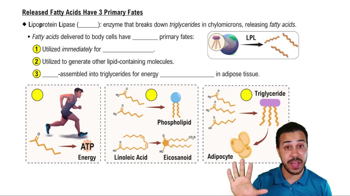
 03:14
03:14