A diverse group of hydrophobic molecules, including fats, oils, and sterols, that do not mix well with water and serve various structural and energy roles.
Hydrophobic
A property describing molecules that repel water, causing them to separate from aqueous solutions, as seen with oils in water.
Amphipathic
A characteristic of molecules containing both hydrophobic and hydrophilic regions, enabling unique functions like membrane formation.
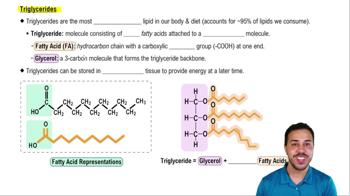
Triglyceride
A molecule composed of three fatty acids attached to a glycerol backbone, serving as the main form of energy storage in adipose tissue.
Fatty Acid
A hydrocarbon chain with a carboxylic acid group at one end, forming part of triglycerides and phospholipids.
Glycerol
A three-carbon molecule that acts as the backbone for triglycerides and phospholipids.
Adipose Tissue
A type of body tissue specialized for storing energy in the form of triglycerides.
Phospholipid
A molecule with two fatty acids and a phosphate-containing glycerol, forming the structural basis of cell membranes.
Phosphate Group
A phosphorus-containing chemical group found in phospholipids, contributing to their hydrophilic properties.
Cell Membrane
A biological barrier primarily composed of phospholipids, controlling the movement of substances into and out of cells.
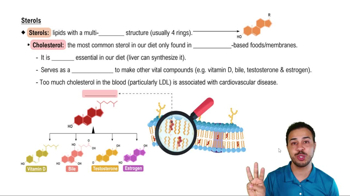
Sterol
A lipid with a multi-ring structure, such as cholesterol, important for membrane fluidity and as a precursor for hormones.
Cholesterol
A sterol found in animal membranes, regulating membrane fluidity and serving as a precursor for vitamin D, bile, and hormones.
Membrane Fluidity
A property of cell membranes influenced by sterols like cholesterol, affecting the flexibility and function of the membrane.
Lipoprotein
A complex particle, such as chylomicrons or LDL, that transports lipids through the bloodstream.
Hormone
A signaling molecule, some of which are synthesized from cholesterol, including sex hormones like testosterone and estrogen.
 Back
Back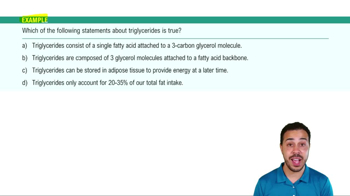
 01:36
01:36