Skip to main content
Nutrition
My Course
Learn
Exam Prep
AI Tutor
Study Guides
Flashcards
Try the app
My Course
Learn
Exam Prep
AI Tutor
Study Guides
Flashcards
Try the app
Back
Macronutrients definitions
You can tap to flip the card.
Macronutrient
You can tap to flip the card.
👆
Macronutrient
A dietary component required in large amounts, providing energy and supporting essential bodily functions.
Track progress
Control buttons has been changed to "navigation" mode.
1/14
Related flashcards
Related practice
Recommended videos
Macronutrients quiz
Macronutrients
15 Terms
Macronutrients exam
Macronutrients
29 Terms
Macronutrients quiz #1
Macronutrients
10 Terms
Macronutrients
1. Science of Nutrition
10 problems
Topic
Micronutrients
1. Science of Nutrition
10 problems
Topic
1. Science of Nutrition
8 topics
15 problems
Chapter
02:38
Macronutrients Example 1
672
views
23
rank
06:10
Carbohydrates, Lipids, & Protein
977
views
32
rank
Terms in this set (14)
Hide definitions
Macronutrient
A dietary component required in large amounts, providing energy and supporting essential bodily functions.
Carbohydrate
A molecule made of carbon, hydrogen, and oxygen, serving as the body's main and preferred energy source.
Simple Sugar
A basic carbohydrate unit, such as glucose, that is easily absorbed into the bloodstream after digestion.
Glucose
A primary simple sugar derived from carbohydrates, crucial for cellular energy and found in plant-based foods.
Lipid
A broad class of hydrophobic molecules, including fats, composed of carbon, hydrogen, and oxygen.
Fat
A type of lipid used for long-term energy storage and preferred during low-intensity exercise.
Fatty Acid
A long hydrocarbon chain forming the building block of fats, insoluble in water and released during digestion.
Triglyceride
A molecule formed by three fatty acids attached to a glycerol backbone, representing the main storage form of fat.
Oil
A liquid fat, typically derived from plants, serving as a dietary source of lipids.
Protein
A macronutrient made of carbon, hydrogen, oxygen, and nitrogen, essential for tissue building and repair.
Amino Acid
A nitrogen-containing molecule serving as the fundamental unit of proteins, each with a unique side chain.
Nitrogen
An element present in proteins and amino acids, distinguishing them from carbohydrates and lipids.
Legume
A plant-based food source, such as beans, rich in protein and classified as a type of seed.
Whole Grain
A plant-derived food containing all parts of the grain, providing carbohydrates and dietary fiber.
 BackBack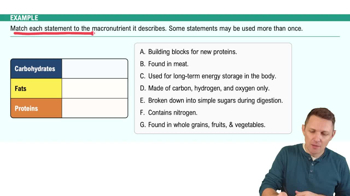
 02:38
02:38