Skip to main content
Nutrition
My Course
Learn
Exam Prep
AI Tutor
Study Guides
Flashcards
Try the app
My Course
Learn
Exam Prep
AI Tutor
Study Guides
Flashcards
Try the app
Back
Nutrition & Physical Activity definitions
You can tap to flip the card.
Macronutrient
You can tap to flip the card.
👆
Macronutrient
A nutrient required in large amounts, such as carbohydrates, proteins, and fats, essential for energy and bodily functions.
Track progress
Control buttons has been changed to "navigation" mode.
1/15
Related flashcards
Related practice
Recommended videos
Nutrition & Physical Activity quiz
Nutrition & Physical Activity
15 Terms
Nutrition & Physical Activity exam
Nutrition & Physical Activity
29 Terms
Nutrition & Physical Activity
11. Nutrition & Fitness
10 problems
Topic
Ergogenic Aids
11. Nutrition & Fitness
10 problems
Topic
11. Nutrition & Fitness
5 topics
15 problems
Chapter
01:25
Nutrition & Physical Activity Example 1
106
views
1
rank
Guided course
02:20
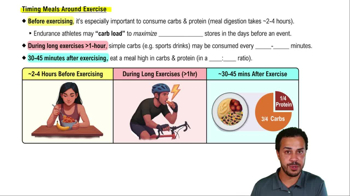
Timing Meals Around Exercise
128
views
Guided course
01:43
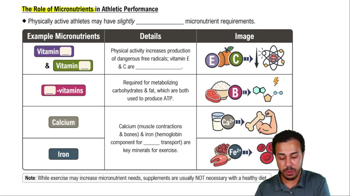
The Role of Micronutrients in Athletic Performance
209
views
Terms in this set (15)
Hide definitions
Macronutrient
A nutrient required in large amounts, such as carbohydrates, proteins, and fats, essential for energy and bodily functions.
Carbohydrate
A primary energy source, especially during high-intensity exercise, and crucial for replenishing glycogen stores.
Protein
A macronutrient vital for muscle growth, repair, and preservation, with increased needs for athletes.
Fat
A macronutrient used for energy, but not preferred during high-intensity activity; intake should remain moderate.
Glycogen
A stored form of carbohydrate in muscles and liver, serving as a critical energy reserve during exercise.
Meal Timing
The strategic scheduling of food intake before and after exercise to optimize energy, recovery, and performance.
Carbohydrate Loading
A strategy used by endurance athletes to maximize muscle glycogen stores in preparation for prolonged events.
Micronutrient
A nutrient needed in small amounts, such as vitamins and minerals, supporting metabolic and physiological functions.
Antioxidant
A compound, like vitamins E and C, that neutralizes free radicals produced during physical activity.
B Vitamin
A group of micronutrients essential for metabolizing carbohydrates and fats to produce ATP for muscle activity.
Calcium
A mineral important for muscle contraction and bone structure, with increased needs in physically active individuals.
Iron
A mineral necessary for hemoglobin formation and oxygen transport, especially important for athletes.
Energy Requirement
The total amount of energy needed daily, which increases with physical activity, especially for athletes.
Saturated Fat
A type of fat that, when consumed in excess, can increase disease risk, even in high-performance athletes.
Glycogen Replenishment
The process of restoring muscle carbohydrate stores after exercise, optimized by post-exercise carbohydrate intake.
 BackBack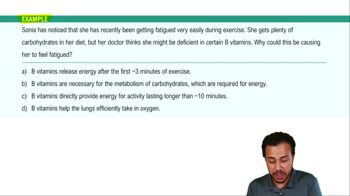
 01:25
01:25