Skip to main content
Nutrition
My Course
Learn
Exam Prep
AI Tutor
Study Guides
Flashcards
Try the app
My Course
Learn
Exam Prep
AI Tutor
Study Guides
Flashcards
Try the app
Back
Organs of the Gastrointestinal Tract definitions
You can tap to flip the card.
Mechanical Digestion
You can tap to flip the card.
👆
Mechanical Digestion
Physical breakdown of food into smaller pieces to increase surface area, primarily through chewing and churning.
Track progress
Control buttons has been changed to "navigation" mode.
1/15
Related flashcards
Related practice
Recommended videos
Organs of the Gastrointestinal Tract quiz
Organs of the Gastrointestinal Tract
15 Terms
Organs of the Gastrointestinal Tract exam
Organs of the Gastrointestinal Tract
29 Terms
Organs of the Gastrointestinal Tract
3. The Human Body & Digestion
10 problems
Topic
Accessory Organs
3. The Human Body & Digestion
10 problems
Topic
3. The Human Body & Digestion
7 topics
15 problems
Chapter
02:10
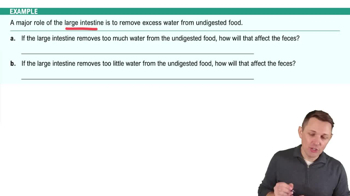
Organs of the Gastrointestinal Tract Example 2
336
views
5
rank
01:29
Organs of the Gastrointestinal Tract Example 4
309
views
1
rank
06:03
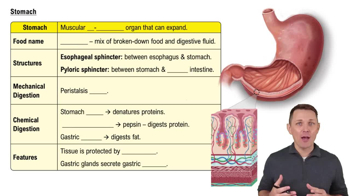
Stomach
410
views
7
rank
Terms in this set (15)
Hide definitions
Mechanical Digestion
Physical breakdown of food into smaller pieces to increase surface area, primarily through chewing and churning.
Chemical Digestion
Process involving enzymes and acids to break down complex food molecules into absorbable units.
Peristalsis
Wave-like muscular contractions that propel food through the digestive tract, even against gravity.
Bolus
Moist, chewed mass of food formed in the mouth and swallowed into the esophagus.
Chyme
Semi-liquid mixture of partially digested food and digestive juices found in the stomach and small intestine.
Sphincter
Ring-like muscle that controls passage between digestive organs, preventing backflow.
Pepsinogen
Inactive precursor molecule secreted in the stomach, activated by acid to become a protein-digesting enzyme.
Gastric Juice
Acidic fluid in the stomach containing hydrochloric acid and digestive enzymes for protein breakdown.
Duodenum
First, short segment of the small intestine where chyme mixes with bile and pancreatic juice.
Jejunum
Middle section of the small intestine, main site for nutrient absorption and chemical digestion.
Ileum
Longest portion of the small intestine, responsible for final absorption of nutrients.
Villi
Finger-like projections lining the small intestine, greatly increasing surface area for absorption.
Microvilli
Microscopic membrane extensions on intestinal cells, forming a brush border to maximize absorption.
Colon
Main region of the large intestine, responsible for water and some mineral absorption from waste.
Gut Microbiome
Diverse community of microorganisms in the large intestine, aiding digestion and vitamin production.
 BackBack
 02:10
02:10