Skip to main content
Nutrition
My Course
Learn
Exam Prep
AI Tutor
Study Guides
Flashcards
Try the app
My Course
Learn
Exam Prep
AI Tutor
Study Guides
Flashcards
Try the app
Back
Using Energy to Fuel Exercise definitions
You can tap to flip the card.
Adenosine Triphosphate
You can tap to flip the card.
👆
Adenosine Triphosphate
A molecule with three phosphate groups that stores and releases energy for cellular processes like muscle contraction.
Track progress
Control buttons has been changed to "navigation" mode.
1/15
Related flashcards
Related practice
Recommended videos
Using Energy to Fuel Exercise quiz
Using Energy to Fuel Exercise
15 Terms
Using Energy to Fuel Exercise exam
Using Energy to Fuel Exercise
26 Terms
Using Energy to Fuel Exercise
11. Nutrition & Fitness
10 problems
Topic
Nutrition & Physical Activity
11. Nutrition & Fitness
10 problems
Topic
11. Nutrition & Fitness
5 topics
15 problems
Chapter
Guided course
02:01
Anaerobic Energy via ATP-CP & Glycolysis
139
views
Guided course
01:54
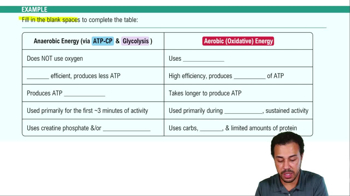
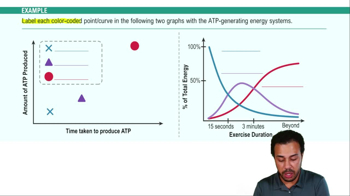
Using Energy to Fuel Exercise Example 2
117
views
Guided course
02:36
Using Energy to Fuel Exercise Example 1
143
views
1
rank
Terms in this set (15)
Hide definitions
Adenosine Triphosphate
A molecule with three phosphate groups that stores and releases energy for cellular processes like muscle contraction.
ATP CP System
An anaerobic energy pathway using creatine phosphate to rapidly regenerate ATP for short, intense activity.
Glycolysis
An anaerobic process breaking down glucose into pyruvate, yielding a small, quick supply of ATP.
Aerobic System
An oxygen-dependent pathway producing large amounts of ATP from carbohydrates and fats during prolonged activity.
Creatine Phosphate
A high-energy compound stored in muscles, donating a phosphate to ADP for rapid ATP regeneration.
Adenosine Diphosphate
A molecule formed when ATP loses a phosphate group, ready to be converted back to ATP.
Phosphate Group
A chemical group transferred between molecules, central to ATP's energy storage and release.
Anaerobic System
An energy pathway operating without oxygen, providing quick but limited ATP for short-duration activities.
Aerobic Metabolism
A process using oxygen to convert nutrients into large amounts of ATP, supporting sustained exercise.
Pyruvate
A product of glycolysis that can enter aerobic metabolism or convert to lactate under anaerobic conditions.
Lactate
A molecule produced from pyruvate during anaerobic metabolism, which can be recycled into glucose by the liver.
Glucose
A carbohydrate broken down during glycolysis to provide energy for muscle activity.
Carbohydrates
Nutrients serving as a primary fuel source for both anaerobic and aerobic energy systems, especially at higher intensities.
Fats
Nutrients metabolized aerobically, providing sustained energy during low-intensity, long-duration exercise.
Muscle Contraction
A biological process powered by ATP, enabling movement and exercise.
 BackBack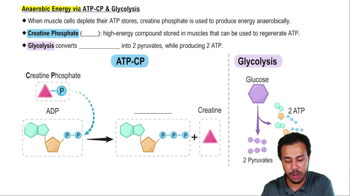
 02:01
02:01