Skip to main content
Nutrition
My Course
Learn
Exam Prep
AI Tutor
Study Guides
Flashcards
Try the app
My Course
Learn
Exam Prep
AI Tutor
Study Guides
Flashcards
Try the app
Back
Why do we need Lipids? definitions
You can tap to flip the card.
Lipids
You can tap to flip the card.
👆
Lipids
A broad group of molecules including fats, essential for energy storage, insulation, cell structure, and nutrient transport.
Track progress
Control buttons has been changed to "navigation" mode.
1/15
Related flashcards
Related practice
Recommended videos
Why do we need Lipids? quiz
Why Do We Need Lipids?
15 Terms
Why do we need Lipids? exam
Why Do We Need Lipids?
26 Terms
Why do we need Lipids?
5. Lipids
10 problems
Topic
Fatty Acids
5. Lipids
10 problems
Topic
5. Lipids
6 topics
15 problems
Chapter
Guided course
01:27
Lipids Are Required in Our Diet
346
views
6
rank
Guided course
01:58
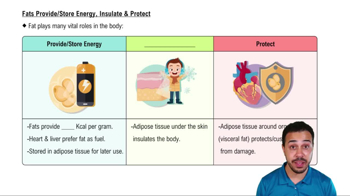
Fats Provide/Store Energy, Insulate & Protect
312
views
3
rank
Guided course
01:49
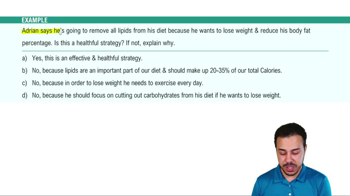
Why Do We Need Lipids? Example 1
270
views
3
rank
Terms in this set (15)
Hide definitions
Lipids
A broad group of molecules including fats, essential for energy storage, insulation, cell structure, and nutrient transport.
Fats
A type of lipid providing dense energy, insulation, organ protection, and enhancing food flavor and satiety.
Adipose Tissue
A body tissue storing fat, insulating the body, and cushioning organs against physical damage.
Energy Density
A measure of calories provided per gram of a nutrient, with fats offering more than double that of carbohydrates or proteins.
AMDR
A recommended range for macronutrient intake, suggesting fats comprise 20-35% of daily energy.
Cell Membrane
A structure formed by phospholipids, controlling the movement of substances into and out of cells.
Cholesterol
A lipid serving as a precursor for vitamin D, bile, and hormones such as testosterone and estrogen.
Phospholipids
Molecules forming the main component of cell membranes, crucial for cellular structure and function.
Visceral Fat
Fat stored around internal organs, providing cushioning and protection from physical impact.
Satiety
A feeling of fullness after eating, often enhanced by the presence of fats in foods.
Fat-Soluble Vitamins
Nutrients such as vitamins A, D, E, and K, which require lipids for absorption and transport in the body.
Bile
A digestive fluid derived from cholesterol, aiding in the breakdown and absorption of dietary fats.
Testosterone
A sex hormone synthesized from cholesterol, important for reproductive and other physiological functions.
Estrogen
A hormone derived from cholesterol, playing a key role in female reproductive health.
Texture
A sensory property of food influenced by fats, contributing to crispiness and mouthfeel.
 BackBack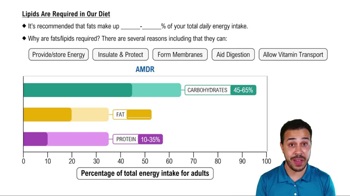
 01:27
01:27