Back

Nutrition Fundamentals and Dietary Guidelines

Control buttons has been changed to "navigation" mode.
1/20
  • What does RDA stand for and what does it represent?

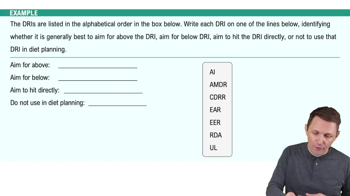
    RDA stands for Recommended Dietary Allowance, which is the average daily intake level sufficient to meet the nutrient requirements of nearly all (97-98%) healthy individuals.
  • Define AI in the context of dietary reference intakes.

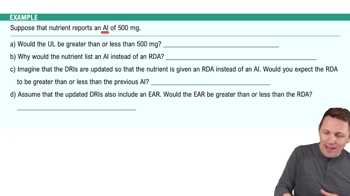
    AI or Adequate Intake is a recommended average daily nutrient intake level based on observed or experimentally determined approximations when RDA cannot be established.
  • What is EAR and its purpose?

    EAR means Estimated Average Requirement, the daily nutrient intake estimated to meet the needs of 50% of healthy individuals in a particular life stage and gender group.
  • Explain TUL in dietary guidelines.

    TUL or Tolerable Upper Intake Level is the highest daily nutrient intake likely to pose no risk of adverse health effects for almost all individuals.
  • What does AMDR stand for and what is its purpose?

    AMDR is the Acceptable Macronutrient Distribution Range, which indicates the recommended percentage of total daily calories from carbohydrates, proteins, and fats to reduce chronic disease risk.
  • State the AMDR ranges for carbohydrates, protein, and fat.

    AMDR for carbohydrates is 45-65%, for protein 10-35%, and for fat 20-35% of total daily calories.
  • Which leading causes of death in the US are nutrition related?

    Nutrition-related leading causes of death include heart disease, stroke, diabetes, and some cancers.
  • What are the four components of nutrition assessment?

    The four components are historical information, anthropometric measurements, physical examination, and laboratory tests to identify nutrient excess or deficiency.
  • Difference between an epidemiological study and a controlled trial?

    An epidemiological study observes relationships in populations, while a controlled trial tests cause-effect by manipulating variables with control groups.
  • Why is a control group used in a controlled trial?

    A control group serves as a baseline to compare effects of the treatment, helping isolate the treatment's impact.
  • Identify dietary risk factors for chronic diseases.

    Risk factors include high saturated fat, added sugars, sodium intake, low fiber, and excessive calorie consumption.
  • Define the diet-planning principle of adequacy.

    Adequacy means providing all essential nutrients, fiber, and energy in amounts sufficient to maintain health.
  • What does the diet-planning principle of balance mean?

    Balance involves consuming foods in proportion to one another and in moderation to avoid excesses or deficiencies.
  • Explain the diet-planning principle of calorie control.

    Calorie control means managing energy intake to maintain a healthy body weight.
  • What is the diet-planning principle of nutrient density?

    Nutrient density refers to foods that provide more nutrients per calorie.
  • Describe the diet-planning principle of moderation.

    Moderation means limiting intake of foods high in added sugars, salt, and unhealthy fats.
  • List the USDA Food Pattern (MyPlate) food groups.

    The groups are fruits, vegetables, grains, protein foods, and dairy.
  • Which foods are found in the USDA fruit group?

    Includes fresh, frozen, canned, and dried fruits, as well as 100% fruit juices.
  • What foods are included in the vegetable group?

    Includes dark green, red and orange vegetables, legumes, starchy vegetables, and others.
  • what the Daily Value on a food label represents?


    The Daily Value shows the percentage of a nutrient in a serving based on a 2,000 calorie daily diet.