 Back
BackNutrition: Lipids
 01:36
01:36
Terms in this set (20)
Lipids are a group of organic compounds that are insoluble in water but soluble in organic solvents. They include fats, oils, phospholipids, and sterols.
Lipids provide energy storage, insulation, protection of organs, and are essential components of cell membranes.
Triglycerides, phospholipids, and sterols.
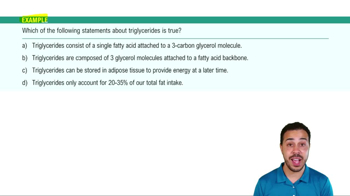
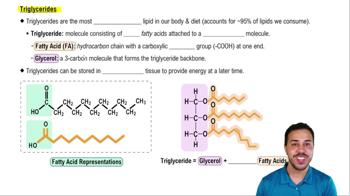
A triglyceride consists of one glycerol molecule bonded to three fatty acid chains.
Saturated fatty acids have no double bonds between carbon atoms, while unsaturated fatty acids have one or more double bonds.
Fatty acids that the body cannot synthesize and must be obtained from the diet, such as linoleic acid and alpha-linolenic acid.
Phospholipids are key components of cell membranes and help in the transport of lipids in the bloodstream.
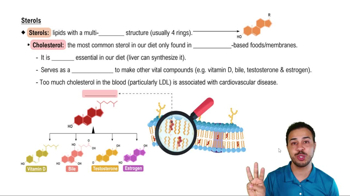
Cholesterol is a sterol important for cell membrane structure, hormone synthesis, and vitamin D production.
Lipids are emulsified by bile salts, broken down by pancreatic lipase into fatty acids and monoglycerides, then absorbed in the small intestine.
Lipids provide about 9 kcal/g, which is more than double the energy from carbohydrates or proteins (4 kcal/g).
Cis fatty acids have hydrogen atoms on the same side of the double bond, causing a bend; trans fatty acids have hydrogens on opposite sides, making them straighter.
Trans fats raise LDL cholesterol and lower HDL cholesterol, increasing the risk of heart disease.
Lipoproteins transport lipids through the bloodstream to tissues and organs.
Chylomicrons, very low-density lipoproteins (VLDL), low-density lipoproteins (LDL), and high-density lipoproteins (HDL).
HDL removes excess cholesterol from tissues and transports it to the liver for excretion.
LDL delivers cholesterol to cells but high levels can lead to plaque buildup in arteries.
Fatty acids have the general formula \(\mathrm{CH_3-(CH_2)_n-COOH}\).
Hydrogenation is the process of adding hydrogen to unsaturated fats to make them more saturated and solid at room temperature.
Omega-3 fatty acids support heart health, reduce inflammation, and are important for brain function.
Fats are typically solid at room temperature, while oils are liquid, due to differences in saturation.