 Back
BackProtein Structure and Amino Acid Basics in Nutrition
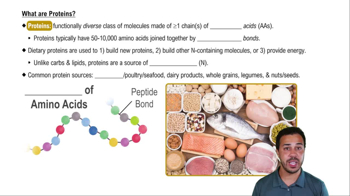
 02:08
02:08
Terms in this set (11)
Primary structure of proteins
This protein structure is a sequence of amino acids in a polypeptide chain.
Secondary structure of proteins
This protein structure is the folding or coiling of the polypeptide chain into alpha-helices or beta-sheets due to hydrogen bonding.
Tertiary structure of proteins
This protein structure is the three-dimensional shape formed by further folding of the secondary structure, stabilized by interactions among side chains.
Quaternary structure of proteins
This protein structure is the association of multiple polypeptide chains into a functional protein complex.
What must happen for amino acids to be used as fuel or stored as fat?
Amino acids must be deaminated (removal of the amino group) before their carbon skeletons can be used for energy or converted to fat.
Essential amino acids
Amino acids that cannot be synthesized by the body and must be obtained from the diet.
Nonessential amino acids
Amino acids that the body can synthesize on its own and do not need to be obtained from food.
Conditionally essential amino acids
Amino acids that are usually nonessential but must be obtained from the diet under certain conditions such as illness or stress.
What happens when a protein is altered by heat, acid, or other disruptive conditions?
The protein undergoes denaturation, losing its natural structure and function.
Complete or high quality protein
A protein source that contains all essential amino acids in adequate amounts for human needs.
Examples of sources of complete proteins
Animal-based foods such as meat, poultry, fish, eggs, and dairy are common sources.