Skip to main content
Personal Health
My Course
Learn
Exam Prep
AI Tutor
Study Guides
Flashcards
Try the app
My Course
Learn
Exam Prep
AI Tutor
Study Guides
Flashcards
Try the app
Back
An Overview of Cancer definitions
You can tap to flip the card.
Neoplasm
You can tap to flip the card.
👆
Neoplasm
New tissue growth lacking physiological function, often forming masses that may be benign or malignant.
Track progress
Control buttons has been changed to "navigation" mode.
1/15
Related flashcards
Related practice
Recommended videos
An Overview of Cancer quiz
An Overview of Cancer
20 Terms
An Overview of Cancer
Ch.10 Major Diseases
5 problems
Topic
Laura
Cancer Risk Factors
Ch.10 Major Diseases
4 problems
Topic
Laura
Ch.10 Major Diseases - Part 1 of 2
4 topics
9 problems
Chapter
Brendan
Ch.10 Major Diseases - Part 2 of 2
3 topics
8 problems
Chapter
Nicole
Guided course
1:31
The Incidence of Cancer Example 4
69
views
Guided course
3:20
Stages of Cancer Concept 3
102
views
1
rank
Guided course
1:06
Introduction to Cancer Example 1
105
views
1
rank
Terms in this set (15)
Hide definitions
Neoplasm
New tissue growth lacking physiological function, often forming masses that may be benign or malignant.
Tumor
A clump of abnormal cells that can be either noncancerous or cancerous, forming as neoplasms grow.
Benign
Noncancerous growth, typically enclosed in a membrane, preventing spread to other tissues.
Malignant
Cancerous growth lacking a membrane, capable of invading nearby tissues and spreading to distant sites.
Biopsy
Procedure involving removal of tissue for examination to determine if a growth is noncancerous or cancerous.
Metastasis
Process where cancer cells travel from the original site to distant organs, forming secondary growths.
Invasion
Initial spread of abnormal cells into surrounding healthy tissues or structures.
Lymphatic System
Network of vessels and nodes that can transport cancer cells to other body regions.
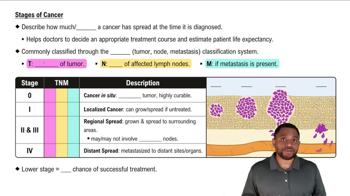
TNM Classification
System for staging cancer based on tumor size, lymph node involvement, and presence of distant spread.
Stage Zero
Earliest cancer stage, marked by a small, localized growth highly curable if detected early.
Stage Four
Most advanced cancer stage, indicating distant spread to other organs and lower survival rates.
Screening
Routine medical checks aimed at early detection of abnormal growths to improve treatment outcomes.
Breast Cancer
Type of cancer with high incidence and mortality among women, often detected through regular exams.
Prostate Cancer
Common cancer in men, frequently identified through screenings and associated with significant mortality.
Lung Cancer
Cancer type responsible for a large proportion of cancer-related deaths in both men and women.
 BackBack


 1:31
1:31