Skip to main content
Personal Health
My Course
Learn
Exam Prep
AI Tutor
Study Guides
Flashcards
Try the app
My Course
Learn
Exam Prep
AI Tutor
Study Guides
Flashcards
Try the app
Back
Factors Affecting Weight definitions
You can tap to flip the card.
Obesity
You can tap to flip the card.
👆
Obesity
Condition marked by excessive fat accumulation, often resulting from a combination of behavioral, biological, and environmental influences.
Track progress
Control buttons has been changed to "navigation" mode.
1/15
Related flashcards
Related practice
Recommended videos
Factors Affecting Weight quiz
Factors Affecting Weight
20 Terms
Factors Affecting Weight
Ch.6 Weight Management
5 problems
Topic
Ally
Risks of Overweight & Obesity
Ch.6 Weight Management
3 problems
Topic
Brendan
Ch.6 Weight Management - Part 1 of 2
5 topics
9 problems
Chapter
Laura
Ch.6 Weight Management - Part 2 of 2
1 topic
2 problems
Chapter
Laura
Guided course
1:39
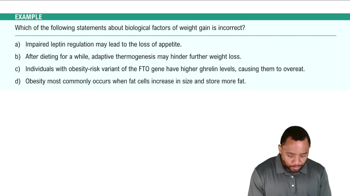
Biology and Genetics Example 2
60
views
1
rank
Guided course
3:38
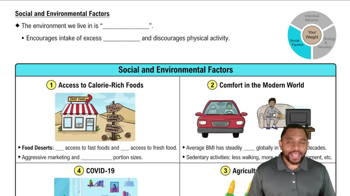
Social and Environmental Factors Concept 3
69
views
1
rank
Guided course
2:18
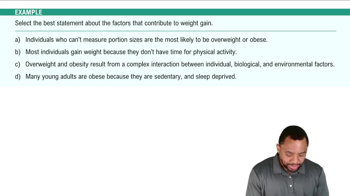
Factors Affecting Weight Example 1
60
views
Terms in this set (15)
Hide definitions
Obesity
Condition marked by excessive fat accumulation, often resulting from a combination of behavioral, biological, and environmental influences.
Basal Metabolic Rate
Amount of energy expended to maintain vital body functions at rest, naturally decreasing with age.
Ghrelin
Hormone that stimulates hunger; elevated levels can lead to persistent feelings of hunger and overeating.
Leptin
Hormone produced by fat cells that signals fullness; impaired regulation can result in continuous eating.
Fat Cells
Cells responsible for storing fat; increased number or size can contribute to higher body weight.
Hypertrophic Obesity
Form of obesity characterized by enlarged fat cells, allowing for greater fat storage.
Hyperplastic Obesity
Form of obesity marked by an increased number of fat cells, often established early in life.
Food Desert
Area with limited access to fresh foods, often leading to reliance on calorie-dense, processed options.
Sedentary Lifestyle
Pattern of minimal physical activity, often due to prolonged sitting and screen-based entertainment.
Screen Time
Duration spent using electronic devices; excessive amounts can disrupt sleep and promote inactivity.
Sleep Deprivation
Insufficient sleep, which is linked to higher body mass index and increased risk of weight gain.
Adaptive Thermogenesis
Process where metabolism slows in response to reduced food intake, often leading to weight regain.
Obesogenic Environment
Surroundings that promote excessive calorie intake and discourage physical activity, increasing obesity risk.
FTO Gene
Genetic variant associated with increased obesity risk and higher hunger hormone levels after eating.
Portion Size
Amount of food served or consumed at one time; larger portions can encourage overeating.
 BackBack


 1:39
1:39