Skip to main content
Personal Health
My Course
Learn
Exam Prep
AI Tutor
Study Guides
Flashcards
Try the app
My Course
Learn
Exam Prep
AI Tutor
Study Guides
Flashcards
Try the app
Back
Factors Affecting Weight quiz
You can tap to flip the card.
What are the three main categories of factors that affect weight?
You can tap to flip the card.
👆
What are the three main categories of factors that affect weight?
The three main categories are individual behaviors, biology and genetics, and social/environmental factors.
Track progress
Control buttons has been changed to "navigation" mode.
1/20
Related flashcards
Related practice
Recommended videos
Factors Affecting Weight definitions
Factors Affecting Weight
15 Terms
Factors Affecting Weight
Ch.6 Weight Management
5 problems
Topic
Ally
Risks of Overweight & Obesity
Ch.6 Weight Management
3 problems
Topic
Brendan
Ch.6 Weight Management - Part 1 of 2
5 topics
9 problems
Chapter
Laura
Ch.6 Weight Management - Part 2 of 2
1 topic
2 problems
Chapter
Laura
Guided course
1:39
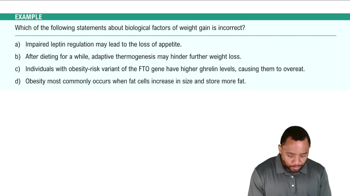
Biology and Genetics Example 2
60
views
1
rank
Guided course
3:38
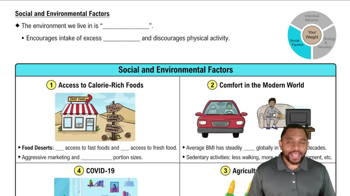
Social and Environmental Factors Concept 3
69
views
1
rank
Guided course
2:18
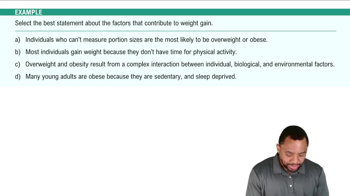
Factors Affecting Weight Example 1
60
views
Terms in this set (20)
Hide definitions
What are the three main categories of factors that affect weight?
The three main categories are individual behaviors, biology and genetics, and social/environmental factors.
How is overweight and obesity defined?
Overweight and obesity are conditions of excess fat deposits in the body.
Why is individual behavior considered a modifiable determinant of weight?
Individual behavior is modifiable because people can make choices about eating, physical activity, and sleep that affect their weight.
What are two examples of individual behaviors that contribute to weight gain?
Excessive eating and physical inactivity are two examples of individual behaviors that contribute to weight gain.
How can social gatherings contribute to excessive eating?
Social gatherings often feature an abundance of food, which can lead to overeating.
What is emotional eating?
Emotional eating is when people eat to soothe anxiety or emotional pain, often leading to excessive food intake.
How do fast food and sugary drinks impact weight?
Fast food is high in fats and sugary drinks are high in sugar, both of which can cause metabolic abnormalities and weight gain.
How much weight can drinking more than one sugary drink a day add in 20 days?
Drinking more than one sugary drink a day can increase weight by about one pound in twenty days.
What role does physical inactivity play in weight gain?
Physical inactivity, such as sitting for long periods at work or school, reduces energy expenditure and contributes to weight gain.
How does increased screen time affect sleep and weight?
Increased screen time can lead to sleep deprivation, which is linked to higher BMIs and weight gain.
Why are biology and genetics considered non-modifiable determinants of weight?
Biology and genetics are non-modifiable because they are inherited and cannot be changed, though their effects can be managed.
What is basal metabolic rate (BMR) and how does it change with age?
BMR is the energy used to maintain vital functions, and it decreases by about 1-2% per year after age 30.
What is adaptive thermogenesis?
Adaptive thermogenesis is when the body slows down metabolism in response to scarce food, often leading to weight cycling.
What is the function of the hormone ghrelin?
Ghrelin is the hunger hormone that increases appetite; high levels can make people feel hungry even after eating.
How does leptin regulate appetite?
Leptin signals satiety and suppresses appetite; impaired leptin regulation can lead to overeating.
Which gene is most associated with obesity risk?
The FTO gene is most associated with obesity risk and can lead to higher ghrelin levels after meals.
What is the difference between hypertrophic and hyperplastic obesity?
Hypertrophic obesity involves increased fat cell size, while hyperplastic obesity involves an increased number of fat cells.
How do social and environmental factors create an obesogenic environment?
Social and environmental factors encourage excess calorie intake and discourage physical activity, promoting weight gain.
What is a food desert and how does it affect weight?
A food desert is an area with limited access to fresh foods, leading to increased consumption of fast food and higher obesity risk.
How did the COVID-19 pandemic impact weight gain in Americans?
During the COVID-19 pandemic, high stress, increased food intake, and reduced physical activity led 42% of Americans to gain an average of 29 pounds.
 BackBack


 1:39
1:39