Skip to main content
Personal Health
My Course
Learn
Exam Prep
AI Tutor
Study Guides
Flashcards
Try the app
My Course
Learn
Exam Prep
AI Tutor
Study Guides
Flashcards
Try the app
Back
Introduction to Overweight & Obesity quiz
You can tap to flip the card.
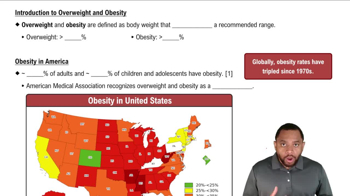
How is overweight defined in terms of body weight percentage above the recommended range?
You can tap to flip the card.
👆
How is overweight defined in terms of body weight percentage above the recommended range?
Overweight is defined as having a body weight that exceeds the recommended range by more than 10%.
Track progress
Control buttons has been changed to "navigation" mode.
1/20
Related flashcards
Related practice
Recommended videos
Introduction to Overweight & Obesity definitions
Introduction to Overweight & Obesity
15 Terms
Introduction to Overweight & Obesity
Ch.6 Weight Management
4 problems
Topic
Nicole
Body Composition
Ch.6 Weight Management
5 problems
Topic
Brendan
Ch.6 Weight Management - Part 1 of 2
5 topics
9 problems
Chapter
Laura
Ch.6 Weight Management - Part 2 of 2
1 topic
2 problems
Chapter
Laura
Guided course
0:54
Introduction to Overweight and Obesity Example 1
213
views
1
rank
Guided course
5:17
Introduction to Overweight and Obesity Concept 1
145
views
1
rank
Terms in this set (20)
Hide definitions
How is overweight defined in terms of body weight percentage above the recommended range?
Overweight is defined as having a body weight that exceeds the recommended range by more than 10%.
What percentage above the recommended range classifies someone as obese?
Obesity is classified as having a body weight that exceeds the recommended range by more than 20%.
Since when have global obesity rates tripled?
Global obesity rates have tripled since the 1970s.
Name two factors that contribute to the rise in obesity rates.
Genetics and environment are two factors that contribute to the rise in obesity rates.
What percentage of U.S. adults are affected by obesity?
About 40% of U.S. adults are affected by obesity.
What percentage of U.S. children and adolescents are affected by obesity?
About 20% of U.S. children and adolescents are affected by obesity.
Which U.S. state is noted for having a lower increase in obesity rates?
Colorado is noted for having a lower increase in obesity rates.
List one possible reason why Colorado has lower obesity rates.
One possible reason is the prevalence of outdoor activities like hiking, skiing, and biking.
How might altitude affect obesity rates according to some scientific communities?
Higher elevation, such as in Colorado, may contribute to lower rates of obesity and overweight.
Which U.S. regions have the highest rates of obesity according to the video?
The Midwest and the South have the highest rates of obesity.
Which racial/ethnic group has the highest prevalence of obesity in the U.S.?
Non-Hispanic Black adults have the highest prevalence of obesity.
Which racial/ethnic group has the lowest prevalence of obesity in the U.S.?
Non-Hispanic Asian adults have the lowest prevalence of obesity.
How can muscle density affect obesity statistics among non-Hispanic Black adults?
Higher muscle density can impact weight readings, potentially affecting obesity statistics.
What dietary habit common in the South may contribute to higher obesity rates?
Fried cooking is more common in the South and may contribute to higher obesity rates.
How does a sedentary lifestyle contribute to obesity?
A sedentary lifestyle reduces physical activity, which can lead to increased obesity rates.
What role does the American Medical Association play regarding obesity?
The American Medical Association recognizes overweight and obesity as diseases.
Why might socioeconomic status influence obesity rates?
Socioeconomic status can affect access to healthy foods and opportunities for physical activity.
What is one reason the Northeast U.S. may have lower obesity rates?
Higher education levels and cultural lifestyle factors may contribute to lower obesity rates in the Northeast.
Why is it important to understand trends in obesity and overweight?
Understanding these trends is crucial for addressing health disparities and promoting disease prevention.
How have changes in technology and entertainment contributed to obesity?
The evolution of video games and apps has led to more sedentary lifestyles, contributing to obesity.
 BackBack


 0:54
0:54