Pathogens & Diseases: Other quiz Flashcards
BackPathogens & Diseases: Other quiz
You can tap to flip the card.
Control buttons has been changed to "navigation" mode.
1/20
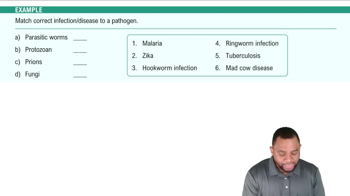
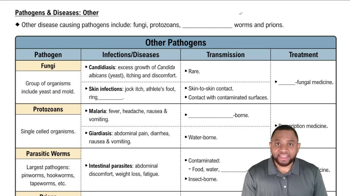
What are the four main types of 'other' pathogens discussed in this lesson?
Fungi, protozoans, parasitic worms, and prions.What type of organism causes candidiasis?
Candidiasis is caused by the yeast Candida albicans, a type of fungus.How are fungal skin infections like athlete's foot and ringworm commonly transmitted?
They are transmitted through skin-to-skin contact or contact with contaminated surfaces.What is the best treatment for fungal infections?
Antifungal medication is the best treatment for fungal infections.What are protozoans?
Protozoans are single-celled organisms that can cause diseases in humans.How is malaria transmitted?
Malaria is transmitted by mosquitoes.What are common symptoms of malaria?
Symptoms include fever, headaches, nausea, and vomiting.How is giardiasis transmitted?
Giardiasis is transmitted through contaminated water.What is the treatment for protozoan infections like malaria and giardiasis?
Prescription medications are used to treat protozoan infections.What are some examples of parasitic worms?
Examples include pinworms, hookworms, and tapeworms.How can parasitic worms be transmitted to humans?
They can be transmitted through contaminated food, water, soil, or by insect vectors.What symptoms are associated with intestinal parasite infections?
Symptoms include abdominal discomfort, weight loss, and fatigue.What is the recommended treatment for parasitic worm infections?
Antiparasitic medication is recommended for treating these infections.What are prions?
Prions are misfolded proteins that cause neurodegenerative diseases.What disease is associated with prion infection?
Creutzfeldt-Jakob disease is associated with prion infection.How is Creutzfeldt-Jakob disease transmitted?
It can be transmitted through consuming contaminated beef.What are symptoms of Creutzfeldt-Jakob disease?
Symptoms include memory loss, seizures, and dementia.Is there a treatment for prion diseases?
No, there is currently no treatment for prion diseases.Why is prevention important for prion diseases?
Because there is no treatment, prevention by avoiding contaminated beef is crucial.Why is understanding different pathogens important for health?
It helps in managing infectious diseases and promoting health by understanding infection, transmission, and treatment.