Skip to main content
Personal Health
My Course
Learn
Exam Prep
AI Tutor
Study Guides
Flashcards
Try the app
My Course
Learn
Exam Prep
AI Tutor
Study Guides
Flashcards
Try the app
Back
Physical Fitness Components definitions
You can tap to flip the card.
Physical Fitness
You can tap to flip the card.
👆
Physical Fitness
Set of attributes enabling the body to perform moderate to vigorous activity without excessive fatigue.
Track progress
Control buttons has been changed to "navigation" mode.
1/15
Related flashcards
Related practice
Recommended videos
Physical Fitness Components quiz
Physical Fitness Components
20 Terms
Physical Fitness Components quiz #1
Physical Fitness Components
40 Terms
Physical Fitness Components quiz #2
Physical Fitness Components
21 Terms
Physical Fitness Components
Ch.7 Exercise and Fitness
5 problems
Topic
Laura
Health Benefits of Exercise
Ch.7 Exercise and Fitness
5 problems
Topic
Nicole
Ch.7 Exercise and Fitness
4 topics
12 problems
Chapter
Laura
Guided course
1:56
Health Components Example 2
70
views
1
rank
Guided course
2:16
Skill Components Concept 3
73
views
1
rank
Guided course
00:54
Skill Components Example 3
54
views
Terms in this set (15)
Hide definitions
Physical Fitness
Set of attributes enabling the body to perform moderate to vigorous activity without excessive fatigue.
Physical Activity
Body movements by skeletal muscles requiring energy, encompassing daily tasks and exercise.
Exercise
Planned, repetitive physical activity designed to improve fitness, such as jogging or running.
Aerobic Activity
Prolonged movement using large muscle groups, increasing heart rate and oxygen intake.
Cardiorespiratory Fitness
Capacity of heart, lungs, and blood vessels to supply oxygen to muscles during activity.
VO2 Max
Maximum volume of oxygen muscles can utilize during intense exercise, indicating aerobic capacity.
Flexibility
Range of motion possible at a joint or group of joints, reducing injury risk during movement.
Body Composition
Relative proportion of fat and lean muscle mass, influencing overall health and physical performance.
Muscular Strength
Maximum force a muscle can produce, often measured by the greatest weight moved in one attempt.
One Repetition Maximum
Highest amount of weight that can be lifted once, used to assess muscular strength.
Muscular Endurance
Ability of muscles to sustain repeated contractions or maintain a position over time.
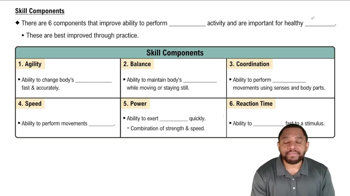
Agility
Ability to change body direction quickly and accurately, essential for injury prevention.
Balance
Capacity to maintain body position while moving or remaining still, supporting mobility and stability.
Coordination
Skill to perform smooth, efficient movements using senses and body parts together.
Reaction Time
Speed at which a person responds to a stimulus, crucial for safety and athletic performance.
 BackBack

 1:56
1:56