Pearson+ LogoPearson+ Logo

Stress Response quiz Flashcards

Back
Stress Response quiz
Control buttons has been changed to "navigation" mode.
1/20
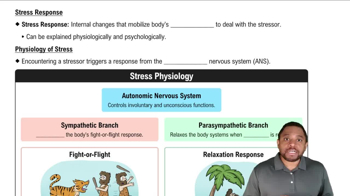
  • What is the stress response?

    The stress response is the internal physiological and psychological changes that mobilize the body's resources to deal with a stressor.
  • Which system primarily manages the physiological stress response?

    The autonomic nervous system (ANS) primarily manages the physiological stress response.
  • What are the two branches of the autonomic nervous system involved in stress?

    The two branches are the sympathetic branch, which activates the fight or flight response, and the parasympathetic branch, which relaxes the body after stress.
  • What hormones are released during the fight or flight response?

    The adrenal glands release epinephrine and cortisol during the fight or flight response.
  • What is the role of epinephrine in the stress response?

    Epinephrine shifts the body into gear for immediate reaction to a stressor.
  • How does cortisol help during stress?

    Cortisol makes nutrients available to the body to help deal with the stressor.
  • What happens when the parasympathetic branch is activated?

    The parasympathetic branch relaxes the body's systems and returns them to homeostasis after the stressor is gone.
  • What is homeostasis?

    Homeostasis is the maintenance of stable body functions.
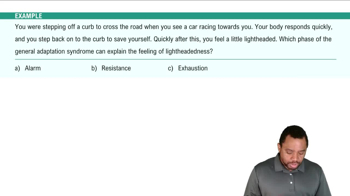
  • What are the three phases of the General Adaptation Syndrome (GAS)?

    The three phases are alarm, resistance, and exhaustion.
  • What occurs during the alarm phase of GAS?

    During the alarm phase, the body becomes aware of the stressor and the sympathetic nervous system is mobilized.
  • What happens in the resistance phase of GAS?

    In the resistance phase, the body tries to sustain homeostasis and adapt to the stressor using internal resources.
  • What characterizes the exhaustion phase of GAS?

    The exhaustion phase is marked by depleted body resources and potential organ wear and tear due to prolonged stress.
  • What is the transactional model of stress and coping?

    The transactional model explains that an individual's stress response is based on their subjective appraisal of a stressor.
  • What are the four stages of the transactional model?

    The four stages are primary appraisal, secondary appraisal, coping, and reappraisal.
  • What is primary appraisal in the transactional model?

    Primary appraisal is the initial assessment of a stressor to determine its significance.
  • What is secondary appraisal in the transactional model?

    Secondary appraisal involves evaluating available resources to cope with the stressor.
  • What factors influence an individual's stress response?

    An individual's coping ability and available resources significantly influence their stress response.
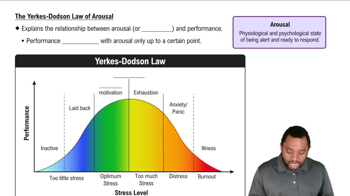
  • What does the Yerkes-Dodson Law describe?

    The Yerkes-Dodson Law describes the relationship between arousal (stress) and performance, showing that optimal stress enhances performance, but too much stress decreases it.
  • What happens to performance when stress is too low or too high according to the Yerkes-Dodson Law?

    Performance is low when stress is too little (inactive) or too much (burnout or distress).
  • What is distress and how does it relate to stress response?

    Distress is a severe form of stress marked by anxiety and panic, often leading to burnout and potential illness.