Skip to main content
Personal Health
My Course
Learn
Exam Prep
AI Tutor
Study Guides
Flashcards
Try the app
My Course
Learn
Exam Prep
AI Tutor
Study Guides
Flashcards
Try the app
Back
The Major Cardiovascular Diseases definitions
You can tap to flip the card.
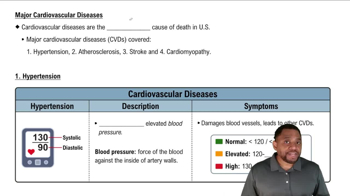
Hypertension
You can tap to flip the card.
👆
Hypertension
Sustained elevation of blood pressure that can damage blood vessels and increase risk for other cardiovascular diseases.
Track progress
Control buttons has been changed to "navigation" mode.
1/17
Related flashcards
Related practice
Recommended videos
The Major Cardiovascular Diseases quiz
The Major Cardiovascular Diseases
20 Terms
The Major Cardiovascular Diseases quiz #1
The Major Cardiovascular Diseases
10 Terms
The Major Cardiovascular Diseases
Ch.10 Major Diseases
5 problems
Topic
Ally
Risk Factors for Cardiovascular Disease
Ch.10 Major Diseases
5 problems
Topic
Laura
Ch.10 Major Diseases - Part 1 of 2
4 topics
9 problems
Chapter
Brendan
Ch.10 Major Diseases - Part 2 of 2
3 topics
8 problems
Chapter
Nicole
Guided course
1:41
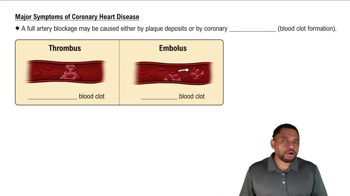
Major Symptoms of Coronary Heart Disease Concept 5
142
views
Guided course
2:11
Hypertension Concept 1
154
views
1
rank
Guided course
1:35
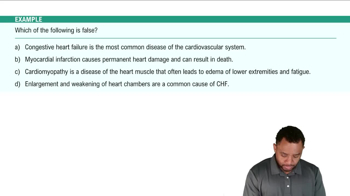
Cardiomyopathy Example 5
57
views
Terms in this set (17)
Hide definitions
Hypertension
Sustained elevation of blood pressure that can damage blood vessels and increase risk for other cardiovascular diseases.
Blood Pressure
Force exerted by circulating blood on artery walls, measured as systolic over diastolic values.
Systolic Pressure
Upper value in blood pressure readings, representing force during heart contraction.
Diastolic Pressure
Lower value in blood pressure readings, representing force during heart relaxation.
Atherosclerosis
Plaque buildup in arteries causing narrowing and hardening, restricting blood flow and increasing risk for heart and limb diseases.
Plaque
Accumulation of fatty substances, cholesterol, calcium, and cellular waste on artery walls.
Peripheral Artery Disease
Atherosclerosis affecting arteries in limbs, leading to cramping, slow wound healing, and possible tissue death.
Coronary Heart Disease
Atherosclerosis in coronary arteries, reducing blood flow to the heart and increasing risk for chest pain and heart attacks.
Angina Pectoris
Severe chest pain from partial artery blockage, often accompanied by shortness of breath and tightness.
Myocardial Infarction
Complete blockage of a coronary artery resulting in permanent heart tissue death, commonly known as a heart attack.
Thrombosis
Formation of a blood clot within a blood vessel, potentially causing arterial blockage.
Thrombus
Stationary blood clot that remains fixed in a blood vessel, obstructing blood flow.
Embolus
Mobile blood clot that travels through the bloodstream, potentially causing blockages in distant vessels.
Stroke
Interruption of blood supply to the brain, resulting in brain tissue death and possible paralysis or death.
Aneurysm
Bulge in a blood vessel wall that may rupture, leading to hemorrhagic stroke or severe bleeding.
Cardiomyopathy
Heart muscle deterioration and enlargement, impairing effective blood pumping and leading to congestive heart failure.
Congestive Heart Failure
Condition where the heart cannot pump blood efficiently, causing fluid buildup in lungs and tissues.
 BackBack



 1:41
1:41