 Back
BackIntroduction to Personal Health: Dimensions, Determinants, and Behavior Change
Study Guide - Smart Notes
 Tailored notes based on your materials, expanded with key definitions, examples, and context.
Introduction to Your Health
Concept of Health and Wellness
Health is defined as the overall conditional state of a person’s physical and mental well-being, regardless of the presence or absence of disease and injury. Wellness represents the ability to make decisions to obtain optimal health and is a dynamic process involving multiple interconnected dimensions.
Health: The state of complete physical, mental, and social well-being, not merely the absence of disease or infirmity.
Wellness: An active process of becoming aware of and making choices toward a healthy and fulfilling life.
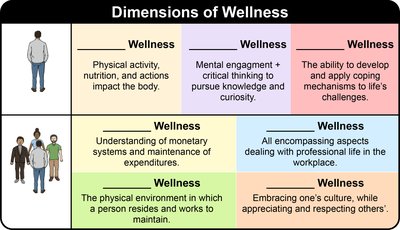
Dimensions of Wellness include:
Physical Wellness: Physical activity, nutrition, and actions impacting the body.
Intellectual Wellness: Mental engagement and critical thinking to pursue knowledge and curiosity.
Emotional Wellness: The ability to develop and apply coping mechanisms to life’s challenges.
Financial Wellness: Understanding monetary systems and managing expenditures.
Occupational Wellness: All-encompassing aspects of professional life in the workplace.
Environmental Wellness: The physical environment in which a person resides and works to maintain.
Cultural Wellness: Embracing one’s culture while appreciating and respecting others.
Life Expectancy and Disease
Life Expectancy and Life Span
Life Expectancy is the average number of years a person is statistically expected to live, while Life Span is the maximum number of years a person could theoretically live (the oldest recorded age is 122 years).
Life expectancy has increased significantly since 1850 due to vaccines, antibiotics, and health policy initiatives.
Life Span = Healthful Life + Disease Life
Factors influencing life expectancy include genetics, sex, economic status, and access to healthcare, but not characteristics like hair color.
Types of Diseases
Chronic Disease: A long-lasting health condition that may require continuous medical attention (e.g., cardiovascular diseases, diabetes, cancer).
Infectious Disease: Caused by pathogens (bacteria, viruses, etc.), some of which are communicable through person-to-person interactions and the environment (e.g., influenza, tuberculosis, malaria, HIV/AIDS).
Population Health
National Health and Its Importance
Population health refers to the collective wellness and health of a population. A healthy population is essential for productivity, creativity, and innovation, while an unhealthy population strains resources and increases healthcare costs.

Leading Contributors and Causes of Death
Leading contributors are lifestyle factors that increase the risk of dying from specific diseases, while leading causes are the specific diseases or conditions responsible for death.
Leading Contributors | # of Deaths (annually) | % of Deaths (annually) | Leading Causes | # of Deaths (annually) | % of Deaths (annually) |
|---|---|---|---|---|---|
Tobacco | 480,000 | 18.0 | Heart Disease | 703,000 | 23.0 |
Diet | 400,000 | 15.0 | Cancer | 608,000 | 22.0 |
Alcohol | 90,000 | 3.5 | Accidents | 227,000 | 6.0 |
Microbes | 80,000 | 3.0 | COVID-19* | 186,552 | 5.4 |
Firearms | 30,000 | 1.1 | Stroke | 165,400 | 5.2 |
Illicit Drug Use | 25,000 | 1.0 | Chronic Lower Respiratory | 147,400 | 5.0 |
Motorized Vehicles | 20,000 | 0.8 | Alzheimer's Disease | 120,000 | 4.2 |
Unsafe Sex | 15,000 | 0.8 | Diabetes | 101,200 | 2.9 |
Additional info: Table values inferred from CDC and NLM data.
Determinants of Health
Overview of Health Determinants
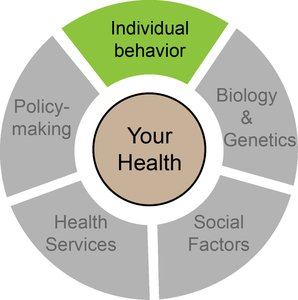
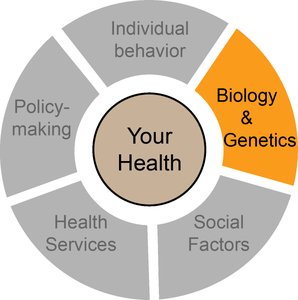
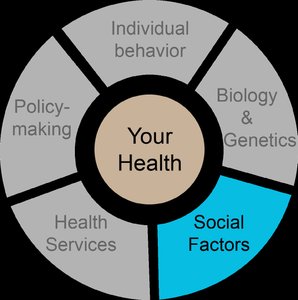
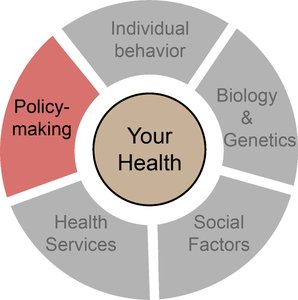
Determinants of health are a range of personal, social, economic, and environmental factors that affect an individual’s health. The Healthy People 2030 initiative emphasizes a broad approach to these determinants.
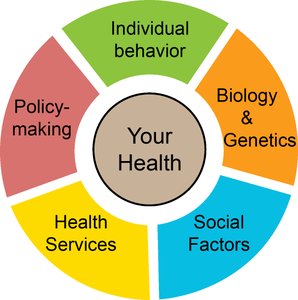
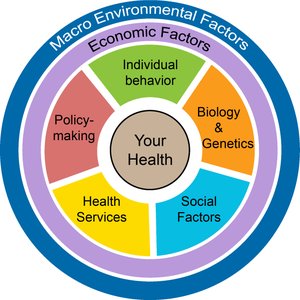
Individual Behavior
Biology & Genetics
Social Factors
Health Services
Policy-making
Individual Behavior (Modifiable Determinants)
Individual behavior is a key determinant of health and is considered modifiable, meaning it can be changed to improve health outcomes.
Lack of Physical Activity
Poor Diet/Nutrition
Excessive Alcohol Use
Tobacco Smoking
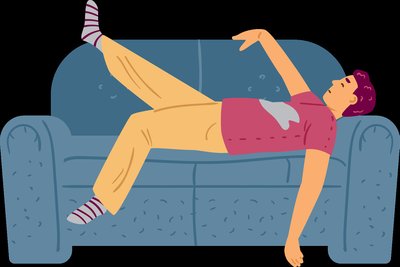
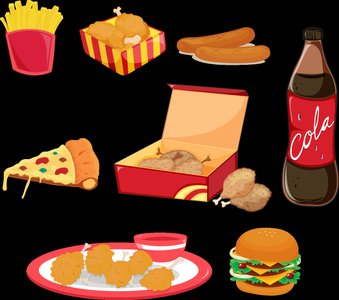

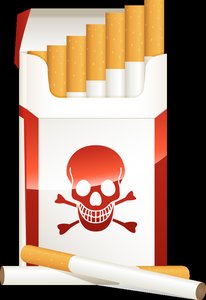
Most chronic diseases are caused by a small number of modifiable determinants. For example, physical activity of 150 min/week reduces risk of death by 33%.
Biology and Genetics (Nonmodifiable Determinants)
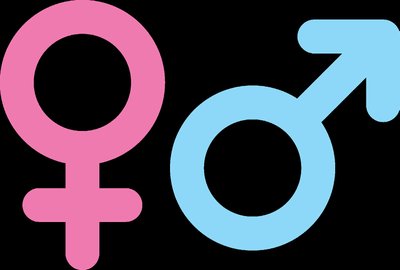
Biology and genetics are nonmodifiable determinants, meaning they cannot be changed by the individual. These include age, sex at birth, race/ethnicity, and health history.
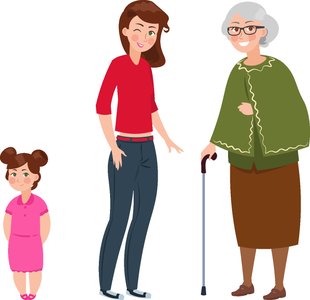

Older age increases risk for cardiovascular diseases, diabetes, cancer, and neurodegenerative disorders.
Sex at birth can influence risk for certain diseases (e.g., males: cardiovascular diseases; females: autoimmune diseases).
Race/ethnicity can be a risk factor (e.g., African Americans: hypertension).
Health history, such as previous infections, can affect disease risk.
Social Determinants of Health
Social determinants are non-medical factors that affect health, including economic stability, education, built environment, and community relationships.


Economic Stability: Ability to afford healthy food, healthcare, and safe living conditions.
Education: Prepares individuals for good work opportunities and fulfilling lives.
Built Environment: Access to parks, pedestrian paths, and healthy food options.
Community: Supportive relationships improve health; unsafe neighborhoods and discrimination reduce it.
Health Services
Access to quality health services is essential for maintaining and improving health. Uninsured or underinsured individuals are at greater risk due to lack of care.
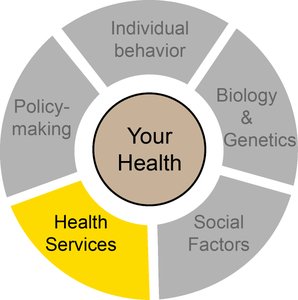
Essential services include doctor visits, vaccinations, and screenings.
Policy-making
Government policies can significantly impact public health through regulations, access to healthcare, and public safety laws.

Examples: Fines for not wearing seatbelts, bans on smoking in public places, universal healthcare policies.
Understanding Behavior Change
Models of Behavior Change
Behavior change is the process of developing healthy habits while overcoming unhealthy ones. Two major models are used to understand this process:
Health Belief Model (HBM): Focuses on four perceptions that influence health behaviors:
Perceived seriousness
Perceived susceptibility
Perceived benefits
Perceived barriers
Transtheoretical Model (Stages of Change): Outlines six stages individuals go through when changing behavior:
Precontemplation
Contemplation
Preparation
Action
Maintenance
Termination
SMART Goals for Behavior Change
Setting SMART goals is a key strategy for successful behavior change:
Specific: Clearly defined activity
Measurable: Progress can be tracked
Attainable: Realistically achievable
Realistic: Practical given circumstances
Time-bound: Has a clear deadline
Example: "I will lose 10 lbs by March 10th by running 3x a week for 30 mins and eating in a caloric deficit of 500."
Key Strategies for Mastering Health Behaviors
Increase awareness of current behaviors and determinants
Contemplate and understand motivation for change
Develop self-efficacy and internal locus of control
Prepare for change with small steps and support systems
Take action, learn from setbacks, and adjust strategies as needed
