 Back
BackLearning: Classical Conditioning, Operant Conditioning, and Observational Learning
Study Guide - Smart Notes
 Tailored notes based on your materials, expanded with key definitions, examples, and context.
Learning
Introduction to Learning
Learning is a fundamental psychological process by which individuals acquire new knowledge, skills, behaviors, or attitudes. It is essential for adaptation and survival, allowing organisms to respond to their environment more effectively. There are three primary forms of learning: classical conditioning, operant conditioning, and observational learning.
Classical Conditioning
Definition and Process
Classical conditioning is a process by which we learn to associate two stimuli and, consequently, to anticipate events. This form of learning was first described by Ivan Pavlov, a Russian physiologist, who discovered it while studying the digestive system. Classical conditioning is evolutionarily beneficial because it enables organisms to develop expectations that help them prepare for both positive and negative events.
Acquisition: The initial period of learning when an association between a neutral stimulus and an unconditioned stimulus is formed.
Example: Developing a dislike for a food after a bad experience (e.g., food poisoning).
Four Components of Classical Conditioning
Unconditioned Stimulus (US): A stimulus that naturally triggers a response without prior learning (e.g., food causing salivation).
Unconditioned Response (UR): The natural, unlearned reaction to the unconditioned stimulus (e.g., salivation in response to food).
Conditioned Stimulus (CS): A previously neutral stimulus that, after being paired with the US, elicits a similar response (e.g., bell sound).
Conditioned Response (CR): The learned response to the conditioned stimulus (e.g., salivation in response to the bell).
Behaviorism and the Little Albert Experiment
John B. Watson and Rosalie Rayner used classical conditioning to study human emotions. In the famous "Little Albert" experiment, they demonstrated that emotional responses such as fear could be conditioned in humans. Stimulus generalization was observed when Little Albert began to fear objects similar to the conditioned stimulus.
Operant Conditioning
Definition and Principles
Operant conditioning is a type of learning in which organisms learn to associate a behavior with its consequences. Behaviors followed by desirable outcomes are more likely to be repeated, while those followed by undesirable outcomes are less likely to recur.
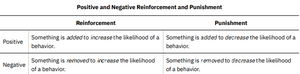
Positive and Negative Reinforcement and Punishment
Operant conditioning involves four main types of consequences:
Reinforcement | Punishment | |
|---|---|---|
Positive | Something is added to increase the likelihood of a behavior. | Something is added to decrease the likelihood of a behavior. |
Negative | Something is removed to increase the likelihood of a behavior. | Something is removed to decrease the likelihood of a behavior. |
Shaping Behaviors
Shaping is a technique used in operant conditioning to guide behavior toward a desired goal by reinforcing successive approximations of the target behavior.
Reinforce any response that resembles the desired behavior.
Reinforce responses that more closely resemble the desired behavior, discontinuing reinforcement for previous responses.
Continue reinforcing closer approximations until only the desired behavior is reinforced.
Types of Reinforcers
Primary Reinforcers: Innate reinforcing qualities that do not require learning (e.g., food, water, sleep, shelter, sex, touch, pleasure).
Secondary Reinforcers: Reinforcers that have no inherent value but gain reinforcing qualities when linked with primary reinforcers (e.g., money, praise, tokens).
Observational Learning
Definition and Process
Observational learning occurs by watching others and then imitating, or modeling, their behaviors. This type of learning is significant in both humans and animals and is sometimes referred to as social learning.
Example: Children learning to tie their shoes by watching their parents.
Albert Bandura and Social Learning Theory
Albert Bandura proposed that learning can occur through observation and imitation of others. He identified three ways learning can occur:
Live: Observing a behavior demonstrated in person.
Verbal: Learning through explanations or descriptions of behavior.
Symbolic: Learning from fictional characters or real people in media.
Key factors for effective social learning include:
Attention: Focusing on the model's behavior.
Retention: Remembering what was observed.
Reproduction: The ability to perform the observed behavior.
Motivation: Having a reason to imitate the behavior, often influenced by reinforcement or punishment.
Vicarious Reinforcement and Punishment
Vicarious Reinforcement: Observing someone else being rewarded for a behavior increases the likelihood of imitating that behavior.
Vicarious Punishment: Observing someone else being punished for a behavior decreases the likelihood of imitating that behavior.
Learning Styles
Types of Learners
Individuals differ in their preferred ways of processing information. The main learning styles include:
Visual Learners: Prefer to see and process information visually. Subtypes include those who memorize by seeing and those who understand by visualizing concepts.
Kinesthetic Learners: Learn best through physical activity, touch, and hands-on experiences. They may struggle with sedentary lessons.
Auditory Learners: Learn best by listening. They often talk to themselves to process information and benefit from discussions and verbal instructions.
Understanding your learning style can help you develop more effective study strategies.
References
Open Textbook: Learning by Association
Learning Style Quiz
