 Back
BackN1015 Nursing Research - Class 5
Study Guide - Smart Notes
 Tailored notes based on your materials, expanded with key definitions, examples, and context.
Nursing Research and Evidence-Based Practice
Introduction to Evidence and Nursing Research
Nursing research is a systematic process that seeks to expand the knowledge base for nursing practice and improve patient outcomes. Evidence-based nursing integrates the best available evidence, clinical expertise, and patient values to inform care decisions.
Evidence: Information or facts that confirm or disprove conclusions; fundamental to health care decision-making.
Nursing Research: Systematic examination of phenomena important to nursing, patients, and families, aiming to answer clinical questions and improve care.
Evidence-Based Practice (EBP): Combines research findings, clinical expertise, and patient preferences for informed decision-making.

Additional info: The historical roots of nursing research are often associated with early nurse leaders who emphasized systematic observation and data collection.
Rationale and Importance of Nursing Research
Nursing research is essential for building the body of knowledge that informs nursing and health care. It advances the quality of care, shapes improvements in health outcomes, and supports evidence-informed decision-making.
Draws on experience, tradition, common sense, clinical expertise, and scientific inquiry.
Promotes health system transformation and innovation.
Encouraged by professional codes of ethics as a means to improve outcomes for clients, nurses, and organizations.

Principles and Process of Nursing Research
Four Principles of Nursing Research
Building the knowledge base of nursing
Describing, explaining, predicting, and controlling phenomena
Strengthening accountability in patient care
Improving the quality of human life
The Research Process
The research process in nursing follows a structured sequence of steps to ensure rigor and reliability in findings.
Formulate a research question
Review relevant literature
Develop a conceptual framework
Choose a research design
Set sample size and selection
Collect data
Analyze data
Communicate results

Types of Evidence and Research Designs
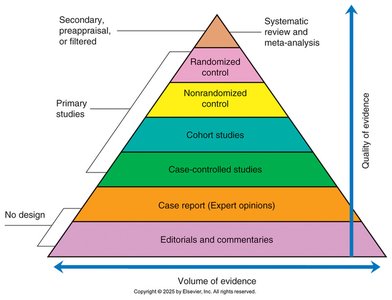
Hierarchy of Evidence
Evidence in health care is ranked by quality and reliability, with systematic reviews and randomized controlled trials at the top.
Level | Type of Evidence |
|---|---|
1 | Systematic reviews and meta-analyses |
2 | Randomized controlled trials |
3 | Nonrandomized controlled studies |
4 | Cohort studies |
5 | Case-controlled studies |
6 | Case reports (expert opinions) |
7 | Editorials and commentaries |
Qualitative Research Designs
Qualitative research seeks to understand human experiences and social phenomena through non-numerical data.
Phenomenology: Describes lived experiences of participants.
Grounded Theory: Explores social processes and develops theory inductively.
Ethnography: Studies cultural groups through observation and participation.
Quantitative Research Designs
Quantitative research uses numerical data and statistical analysis to test relationships, differences, and cause-effect hypotheses.
Non-experimental: Exploratory, descriptive, correlational, and comparative studies.
Experimental: Involves randomization, control groups, and manipulation of variables (e.g., clinical trials).
Quasi-experimental: Similar to experimental but lacks randomization or identical control groups.
Variables in Research
Independent Variable: Manipulated or changed by the researcher.
Dependent Variable: Outcome measured in the study; depends on the independent variable.
Confounding/Extraneous Variables: Not under study but may affect outcomes.
Sampling and Data Collection
Population and Sample
The population is the entire group relevant to the research question, while the sample is a representative subset studied to draw conclusions.
Sample selection must avoid bias and be representative.
Sample size and selection affect the generalizability of findings.
Ethical considerations are paramount; human subject review is required.


Data Collection Methods
Quantitative: Surveys, questionnaires, physical measurements (e.g., thermometers, scales).
Qualitative: Interviews, focus groups, observations.


Validity and Reliability
Data collection tools must be valid (measure what they are intended to measure) and reliable (produce consistent results).
Inter-rater reliability: Consistency between different observers.
Test-retest reliability: Consistency over time.
Internal consistency: Consistency among items within a tool.
Data Analysis and Interpretation
Qualitative Data Analysis
Involves synthesizing narrative data to identify themes and categories, without statistical analysis.
Quantitative Data Analysis
Uses statistical methods to analyze numerical data. Types of statistics include:
Descriptive statistics: Summarize data (e.g., mean, median, mode).
Inferential statistics: Draw conclusions about populations based on sample data.

Statistical Significance
Statistical significance indicates whether results are likely due to chance. In nursing research, a p-value less than 0.05 is considered significant.
p-value < 0.05: Results are unlikely due to chance alone (95% confidence).

Interpreting and Communicating Results
Findings must be interpreted in the context of existing research and communicated through presentations, reports, and publications. Peer review ensures quality and credibility.
Research articles include title, abstract, introduction, literature review, methods, results, discussion, and implications.


Research-Mindedness and Barriers
Research-Mindedness in Nursing
Nurses should maintain a positive attitude toward research, regularly read and understand research reports, and implement findings in practice.
Engagement in research improves patient care and advances the profession.
Barriers to Research Utilization
Disconnect between research and practice
Clinical workload and time constraints
Difficulties in understanding research
Organizational climate not supportive of research
Relevance to Health Promotion
Nursing research is directly relevant to health promotion, as it helps identify effective interventions, measure outcomes, and improve population health.
Nurses contribute to health promotion by applying research findings to practice and evaluating intervention outcomes.
