 Back
BackPersonal Health: Introduction, Dimensions, and Determinants
Study Guide - Smart Notes
 Tailored notes based on your materials, expanded with key definitions, examples, and context.
Introduction to Your Health
Concept: What is Health?
Health is defined as the overall conditional state of a person’s physical and mental well-being, whether in the presence or absence of disease and injury. Wellness represents the ability to make decisions to obtain optimal health, emphasizing proactive choices and behaviors. The concept of wellness includes several interconnected dimensions that contribute to overall health.
Health: The state of complete physical, mental, and social well-being, not merely the absence of disease or infirmity.
Wellness: The process of actively making choices toward a healthy and fulfilling life.
Dimensions of Wellness
Wellness is multi-dimensional, encompassing various aspects of life that interact to influence overall health. Each dimension contributes uniquely to a person’s well-being.
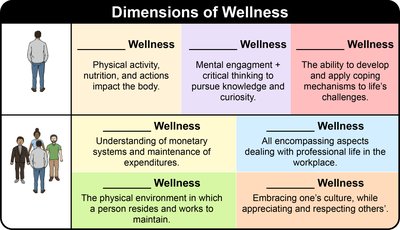
Physical Wellness: Physical activity, nutrition, and actions impact the body.
Intellectual Wellness: Mental engagement and critical thinking to pursue knowledge and curiosity.
Emotional Wellness: The ability to develop and apply coping mechanisms to life’s challenges.
Financial Wellness: Understanding monetary systems and maintenance of expenditures.
Occupational Wellness: All-encompassing aspects dealing with professional life in the workplace.
Environmental Wellness: The physical environment in which a person resides and works to maintain.
Cultural Wellness: Embracing one’s culture while appreciating and respecting others.
Determinants of Health
Overview of Determinants
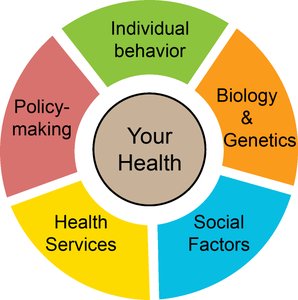
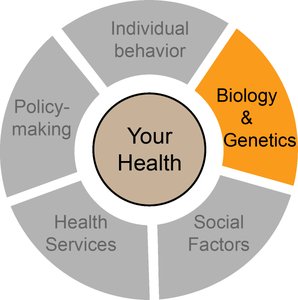
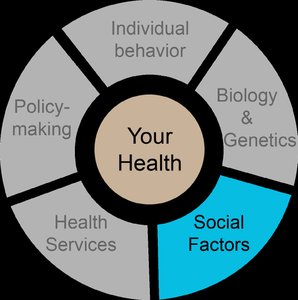
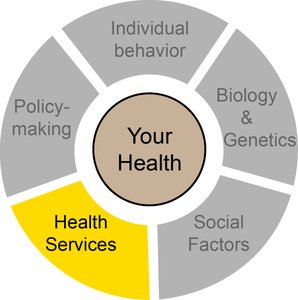
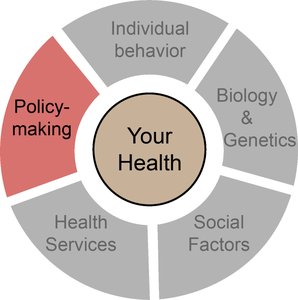
Health is influenced by a range of determinants, which are factors that affect an individual’s ability to get healthy and stay healthy. These determinants are categorized as modifiable and nonmodifiable, and also include social, healthcare, and policy factors.
Modifiable Determinants: Behaviors that individuals can change, such as physical activity, diet, alcohol use, and tobacco smoking.
Nonmodifiable Determinants: Traits or innate characteristics that cannot be changed, such as age, sex at birth, race/ethnicity, and health history.
Social Determinants: Economic stability, education, built environment, and community relationships.
Health Services: Access to quality health services, including doctor visits, vaccinations, and screenings.
Policy-making: Government policies and interventions that affect public health.
Modifiable Determinants of Health
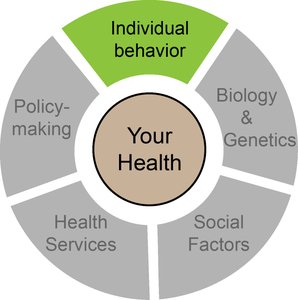
Modifiable determinants are behaviors within an individual’s power to change. These are critical in preventing chronic diseases and improving health outcomes.
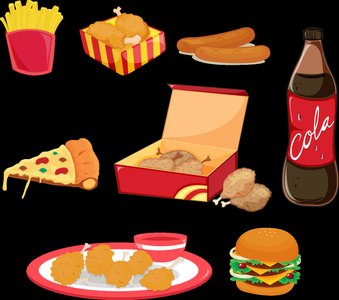
Lack of Physical Activity: Sedentary lifestyle increases risk of chronic diseases.
Poor Diet/Nutrition: Eating less fruits and vegetables increases risk of all-cause mortality.
Excessive Alcohol Use: Responsible for numerous deaths annually; causes heart/liver diseases, cancer, accidents, and violence.
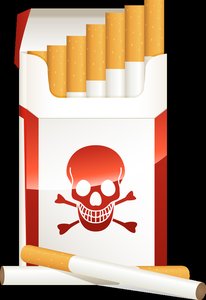
Tobacco Smoking: Responsible for many deaths annually, including those from second-hand smoke.

Nonmodifiable Determinants of Health
Nonmodifiable determinants are innate characteristics that cannot be changed but can influence disease risk and health outcomes.
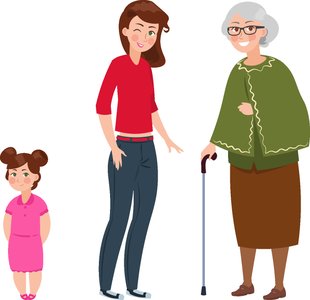
Age: Older individuals are at higher risk for cardiovascular diseases, diabetes, cancer, and neurodegenerative disorders.
Sex at Birth: Biological differences can affect disease risk (e.g., males: cardiovascular diseases; females: autoimmune diseases, UTIs).
Race/Ethnicity: Certain populations have higher risks for specific diseases (e.g., African Americans: hypertension).
Health History: Previous infections or conditions can increase future disease risks.

Social Determinants of Health
Social determinants are non-medical factors that affect health, including economic stability, education, built environment, and community relationships. These factors often have a greater impact on health than individual behavior or biological factors.
Economic Stability: Steady income enables access to healthy food, healthcare, and safe environments.
Education: Good education prepares individuals for work opportunities and enables them to thrive.
Built Environment: Human-made surroundings, such as parks and bike lanes, contribute to health.
Community: Supportive relationships improve health and well-being; unsafe neighborhoods and discrimination reduce it.



Health Services
Access to quality health services is essential for maintaining health and increasing life expectancy. Essential services include doctor visits, vaccinations, and screenings. Uninsured or underinsured individuals are at greater risk due to limited access to care.
Doctor Visits/Check-ups: Regular health assessments help detect and prevent diseases.
Vaccinations: Prevent infectious diseases and improve population health.
Screenings: Early detection of diseases leads to better outcomes.
Policy-making
Government policies and interventions can significantly impact public health. Examples include seatbelt laws, bans on smoking in public places, and access to affordable healthcare.
Seatbelt Laws: Reduce injuries and fatalities in motor vehicle accidents.
Smoking Bans: Protect public health by reducing exposure to tobacco smoke.
Universal Healthcare: Ensures equitable access to health services for all citizens.

Understanding Behavior Change
Behavior Change Models
Behavior change is a process of developing healthy habits while overcoming unhealthy ones. Two major models are used to understand and facilitate behavior change: the Health Belief Model and the Transtheoretical Model.
Health Belief Model (HBM): Focuses on perceived seriousness, susceptibility, benefits, and barriers to behavior change.
Transtheoretical Model (Stages of Change): Outlines sequential stages individuals go through when changing behavior: precontemplation, contemplation, preparation, action, maintenance, and termination.

Health Belief Model (HBM)
The Health Belief Model posits that four factors influence health behaviors:
Perceived Seriousness: How severe or dangerous are the consequences if no change occurs?
Perceived Susceptibility: What are your chances of experiencing these consequences?
Perceived Benefits: Will the behavior change benefit you?
Perceived Barriers: Are barriers greater than potential benefits?
Transtheoretical Model (Stages of Change)
The Transtheoretical Model describes six stages of behavior change:
Precontemplation: Unawareness of a problem or no intention to change.
Contemplation: Acknowledging a problem and considering change within six months.
Preparation: Planning and setting a goal to take action within one month.
Action: Actively implementing the behavior change.
Maintenance: Sustaining the new behavior for at least six months.
Termination: New behavior is integrated into daily life with little temptation to revert.
Mastering Your Health Behaviors
Applying Behavior Change
To master health behaviors, individuals must increase awareness, contemplate change, prepare for change, take action, and maintain new behaviors. Setting SMART goals is essential for success.
Self-efficacy: The belief in one’s ability to achieve something.
Internal Locus of Control: The belief that one’s own decisions and actions influence outcomes.
SMART Goals: Goals should be Specific, Measurable, Attainable, Realistic, and Time-bound.
Example SMART Goal: "I will lose 10 lbs by March 10th by running 3x a week for 30 mins and eating in a caloric deficit of 500."
Strategies for Successful Behavior Change
Countering: Replace negative behaviors with positive ones.
Controlling Situation: Modify environment to support new behaviors.
Positive Self-talk: Encourage oneself to stay motivated.
Positive Reinforcement: Reward progress.
Journaling: Track progress and reflect on challenges.
Learning from setbacks and adjusting strategies is crucial for maintaining behavior change.
References
U.S. Department of Health and Human Services, Office of Health Promotion and Disease Prevention, Healthy People 2030 Framework
Centers for Disease Control and Prevention. About chronic diseases.
Kaminsky, L. A., et al. The importance of healthy lifestyle behaviors in the prevention of cardiovascular disease.
World Health Organization. Social Determinants of Health.
