Skip to main content
Physics with Algebra
My Course
Learn
AI Tutor
Study Guides
Flashcards
Explore
Try the app
My Course
Learn
AI Tutor
Study Guides
Flashcards
Explore
Try the app
Back
Chapter 13 module
You can tap to flip the card.
What is the principle of flotation?
You can tap to flip the card.
👆
What is the principle of flotation?
A floating object displaces a weight of fluid equal to its own weight.
Track progress
Control buttons has been changed to "navigation" mode.
1/24
Recommended videos
Guided course
06:55
Maximum Load on Floating Board
84
views
Guided course
16:56
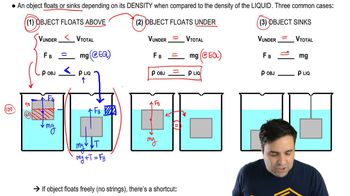
Buoyancy / Three Common Cases
155
views
Guided course
03:14
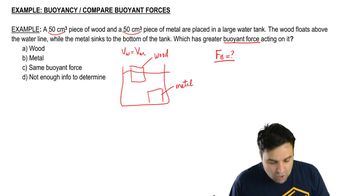
Comparing Buoyant Forces
139
views
Terms in this set (24)
Hide definitions
What is the principle of flotation?
A floating object displaces a weight of fluid equal to its own weight.
Who discovered the relationship between buoyancy and displaced liquid?
Archimedes, a 3rd-century BC Greek scientist.
What does total pressure in a fluid refer to?
The sum of atmospheric pressure and the pressure from the liquid.
Why does a thin layer of fat rise and float on cold soup in a refrigerator?
Because when the soup cools, the surface tension increases.
What buoyancy rule applies to a fish swimming in water?
The fish has a density equal to the density of the fluid it is immersed in.
On what two factors does the pressure in a liquid depend?
The depth of the submerged object and the density of the liquid.
Who discovered that pressure in a fluid is transmitted without loss?
Blaise Pascal, a 17th-century scientist.
What condition causes an object to sink in a fluid?
The object is denser than the fluid in which it is immersed.
What is adhesion?
The attraction of unlike materials to one another.
Name devices that rely on Pascal's principle.
Pumping stations, construction equipment, and automobile lifts.
What condition causes an object to float in a fluid?
The object is less dense than the fluid in which it is immersed.
What is the net upward force on an object submerged in a fluid called?
The buoyant force.
What causes the hairs on a paintbrush to stick together when pulled out of water?
Surface tension.
Where would a swimmer feel more pressure: 10 feet below a freshwater lake or a pool?
Neither; pressure depends only on depth, not the size of the body of water.
How compressible are liquids?
Liquids are practically incompressible.
What principle does a hydraulic lift in an automobile service station obey?
Pascal's principle.
When a stone is submerged in water, what volume of water does it displace?
A volume of water equal to the volume of the stone.
Why does pressure increase as you swim deeper in a lake?
Because pressure increases with depth.
Why is the net force on a submerged object upward?
Pressure is greater on the bottom of the object due to its depth.
What happens to water flow from holes at different depths in a bucket?
Water from the bottom hole spurts farthest; the top hole spurts the least.
What causes water to seep up hair into the scalp in a sink or bathtub?
Capillary action.
How does a boat's floating level change between salt water and fresh water?
A boat floats higher in fresh water than in salt water.
What is cohesion?
The attraction of like materials to one another.
Write the formula for pressure in terms of force and area.
Pressure = Force / Area, represented as \(P=\frac{F}{A}\).
 BackBack
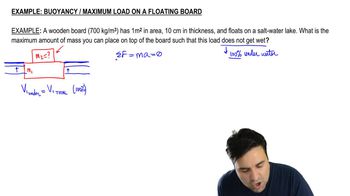
 06:55