- Download the worksheet to save time writing
- Start solving the practice problems
- If you're stuck, watch the video solutions
- See your summary to get more insights

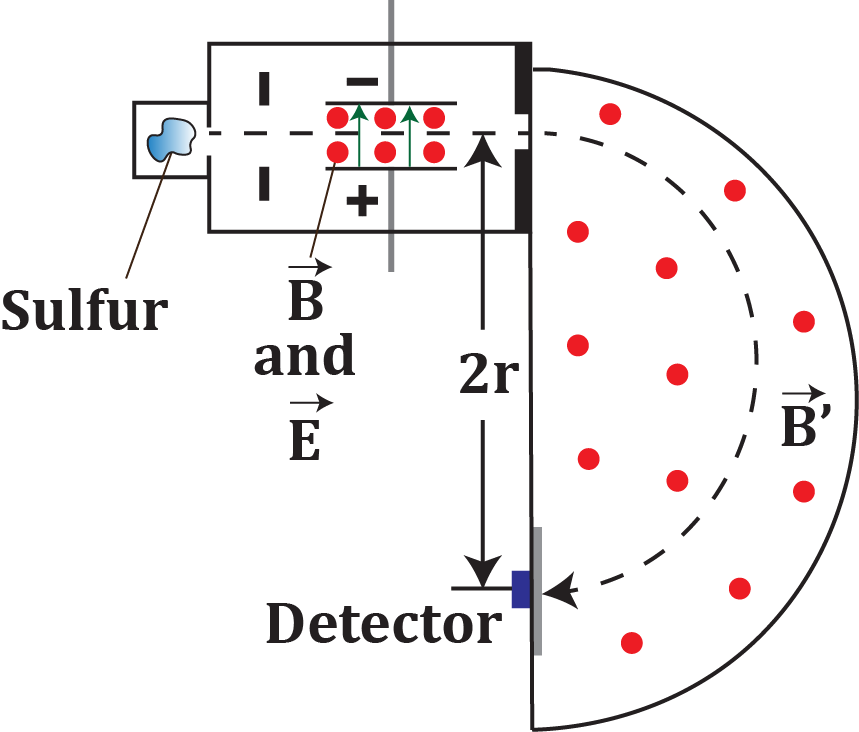
A mass spectrometer uses sulfur isotopes of mass numbers 32, 33, and 34 from a meteorite sample. The electric field between the plates is 2.9×10⁴ V/m and the magnetic fields are B = B' = 0.60 T and their directions are shown below. To estimate atomic masses, multiply by 1.67×10⁻²⁷ kg. How far apart are the marks formed by singly charged ions of each type on a detector film? Hint: The mass m of an isotope in this spectrometer is equal to qBB'r/E and charge q=1.602×10⁻19 C.
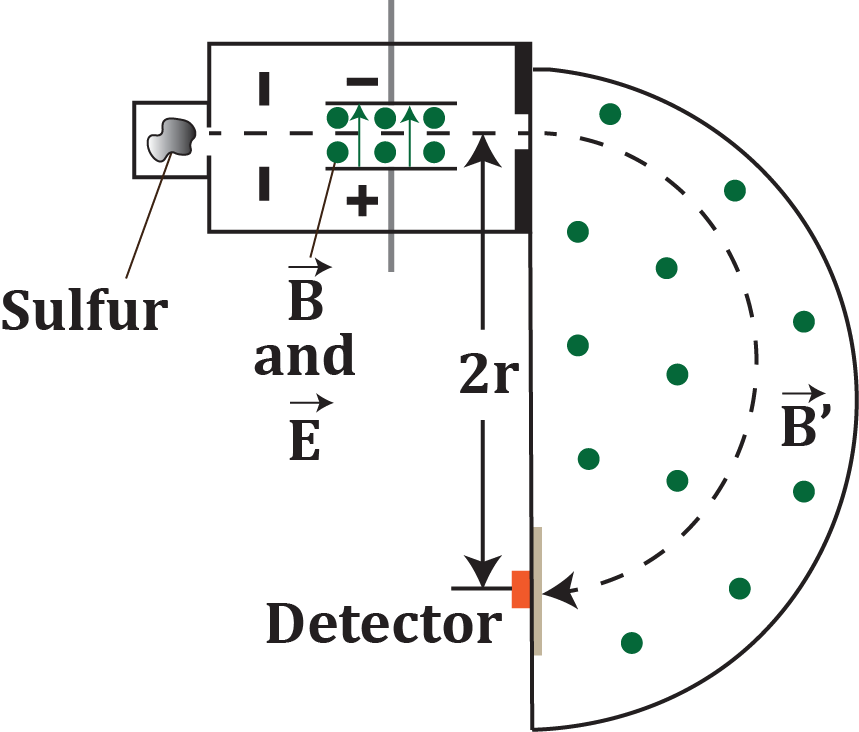
A mass spectrometer uses sulfur isotopes of mass numbers 32, 33, and 34 from a meteorite sample. The directions of the electric field between the plates and the magnetic fields are shown below. The marks formed by singly charged ions of each type on a detector film are equally spaced based on this expression: . Does it matter if the ion charge is positive (lost electrons) or negative (gained electrons)? Explain.