In two-dimensional motion, at what point(s) during an object's path is it speeding up?
An object is speeding up at points where the velocity and acceleration vectors have components in the same direction, causing the magnitude of velocity to increase.
During two-dimensional motion, at what point in the motion does the acceleration have its greatest magnitude?
The acceleration has its greatest magnitude at the point where the change in velocity per unit time (ΔV/ΔT) is largest, which can occur when either the magnitude or direction of velocity changes most rapidly.
In two-dimensional motion, at what point(s) labeled along the path is the object speeding up?
The object is speeding up at points where the direction of the acceleration vector aligns with the direction of the velocity vector, resulting in an increase in the speed of the object.
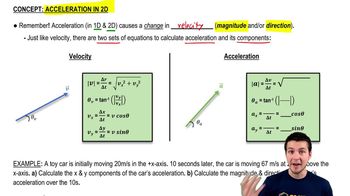
What equation is used to calculate the magnitude of acceleration in two-dimensional motion if you know the x and y components?
The magnitude is calculated using the Pythagorean theorem: \( a = \sqrt{a_x^2 + a_y^2} \). This gives the total acceleration from its components.
How do you determine the direction of the acceleration vector in two dimensions?
The direction is found using the inverse tangent function: \( \theta = \tan^{-1}(a_y/a_x) \). This gives the angle relative to the x-axis.
If a car's initial velocity is only in the x direction, what is its initial velocity component in the y direction?
The initial velocity component in the y direction is 0 m/s. This is because the car is not moving vertically at the start.
What information do you need to calculate the x and y components of acceleration using changes in velocity?
You need the initial and final velocity components in both x and y directions, as well as the time interval. The components are found by dividing the change in each velocity component by the time.
How do you find the x and y components of a velocity vector given its magnitude and direction?
The x component is found by multiplying the magnitude by the cosine of the angle, and the y component by multiplying by the sine of the angle. This breaks the vector into its horizontal and vertical parts.
What does it mean if both the magnitude and direction of velocity change for an object?
It means the object is experiencing acceleration in two dimensions. Both a change in speed and a change in direction contribute to the overall acceleration.
Why is it important to distinguish between the velocity vector and the acceleration vector when solving problems?
The velocity vector describes the object's motion, while the acceleration vector describes how that motion is changing. Confusing the two can lead to incorrect calculations of components or magnitude.
 Back
Back
 08:17
08:17