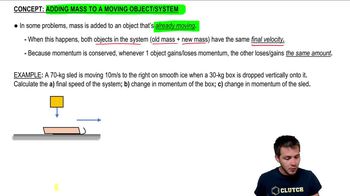
Adding Mass to a Moving System definitions Flashcards
Adding Mass to a Moving System definitions
You can tap to flip the card.
Control buttons has been changed to "navigation" mode.
1/15
Inelastic CollisionA type of collision where colliding objects stick together, resulting in a common final velocity.Momentum ConservationA principle stating that the total momentum of a closed system remains constant if no external forces act on it.Final VelocityThe velocity of a system after a collision or interaction, calculated using momentum conservation.Initial VelocityThe velocity of an object or system before a collision or interaction occurs.Horizontal MomentumMomentum in the horizontal direction, unaffected by vertical forces or velocities.Vertical VelocityThe component of velocity in the vertical direction, which does not affect horizontal momentum.MassA measure of the amount of matter in an object, influencing its momentum and velocity.SystemA set of interacting or interdependent components forming an integrated whole, such as a sled and box.MomentumA quantity of motion of a moving body, calculated as the product of its mass and velocity.Change in MomentumThe difference in an object's momentum before and after an interaction, indicating a transfer of momentum.Transfer of MomentumThe process by which momentum is exchanged between objects in a system, maintaining total momentum.SpeedThe magnitude of velocity, representing how fast an object is moving regardless of direction.KilogramThe SI unit of mass, used to quantify the amount of matter in an object.Meter per SecondThe SI unit of speed or velocity, indicating how many meters an object travels in one second.Momentum EquationAn equation used to calculate momentum, typically expressed as mass times velocity.