Skip to main content
Physics with Calculus
My Course
Learn
Exam Prep
AI Tutor
Study Guides
Textbook Solutions
Flashcards
Explore
Try the app
My Course
Learn
Exam Prep
AI Tutor
Study Guides
Textbook Solutions
Flashcards
Explore
Try the app
Back
Adding Vectors by Components definitions
You can tap to flip the card.
Resultant Vector
You can tap to flip the card.
👆
Resultant Vector
The vector representing the shortest path from the start of the first vector to the end of the last vector.
Track progress
Control buttons has been changed to "navigation" mode.
1/15
Related flashcards
Related practice
Recommended videos
Adding Vectors by Components quiz
Adding Vectors by Components
9 Terms
Adding Vectors by Components quiz #1
Adding Vectors by Components
10 Terms
Adding Vectors by Components
3. Vectors
7 problems
Topic
Patrick
Trig Review
3. Vectors
5 problems
Topic
Patrick
3. Vectors - Part 1 of 2
4 topics
9 problems
Chapter
Patrick
3. Vectors - Part 2 of 2
5 topics
13 problems
Chapter
Patrick
Guided course
07:30
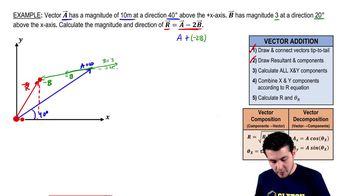
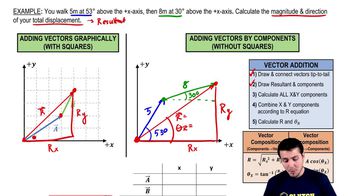
Vector Addition By Components
17349
views
334
rank
8
comments
Guided course
06:26
Adding Vectors
10862
views
303
rank
7
comments
Terms in this set (15)
Hide definitions
Resultant Vector
The vector representing the shortest path from the start of the first vector to the end of the last vector.
Displacement
A vector quantity that refers to the change in position of an object.
Magnitude
The length or size of a vector, often calculated using the Pythagorean theorem.
Direction
The angle a vector makes with a reference axis, often calculated using the tangent inverse function.
Components
The projections of a vector along the axes of a coordinate system, typically horizontal and vertical.
Trigonometric Functions
Functions like sine and cosine used to decompose vectors into components.
Pythagorean Theorem
A mathematical equation used to calculate the magnitude of a vector from its components.
Tangent Inverse
A function used to determine the angle of a vector from its components.
Vector Decomposition
The process of breaking a vector into its horizontal and vertical components.
Tip to Tail
A method of adding vectors by connecting the tail of one vector to the tip of another.
Origin
The starting point in a coordinate system from which vectors are drawn.
Theta
The symbol commonly used to represent an angle in trigonometry and vector calculations.
Coordinate System
A system that uses numbers to represent a point, line, or the like in space.
Vector Addition
The process of combining vectors to determine a resultant vector.
Vector Math Equations
Equations used to calculate vector properties such as magnitude and direction.
 BackBack
 07:30
07:30