Adding Vectors Graphically quiz #1 Flashcards

Adding Vectors Graphically quiz #1
Control buttons has been changed to "navigation" mode.
1/10
  • How is the parallelogram method for vector addition represented graphically, and how does it relate to the tip-to-tail method?
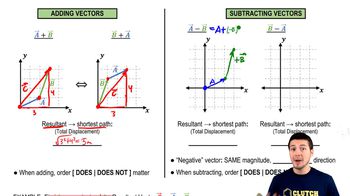
    The parallelogram method for vector addition is represented by placing two vectors so that they start from the same point. Then, a parallelogram is formed by drawing lines parallel to each vector from the tip of the other. The resultant vector is represented by the diagonal of the parallelogram starting from the common origin. This method is equivalent to the tip-to-tail method, as both yield the same resultant vector.
  • How do you graphically represent the vector sum d⃗ = a⃗ + b⃗ using the tip-to-tail method?
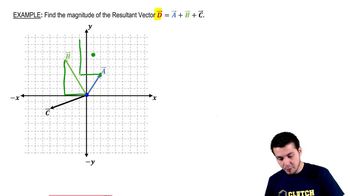
    To graphically represent d⃗ = a⃗ + b⃗, draw vector a⃗ as an arrow. From the tip (end) of a⃗, draw vector b⃗ as another arrow. The resultant vector d⃗ is then drawn from the tail (start) of a⃗ to the tip (end) of b⃗. This resultant vector represents the sum of a⃗ and b⃗.
  • How do you graphically represent the vector difference c⃗ = a⃗ − b⃗?
    To graphically represent c⃗ = a⃗ − b⃗, first draw vector a⃗. Then, draw the negative of vector b⃗ (which has the same magnitude as b⃗ but points in the opposite direction) starting from the tip of a⃗. The resultant vector c⃗ is drawn from the tail of a⃗ to the tip of the negative b⃗. This resultant vector represents the difference a⃗ − b⃗.
  • What is the resultant vector in the context of vector addition?
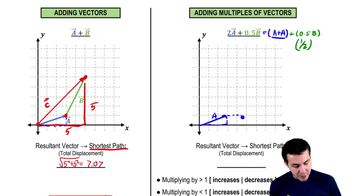
    The resultant vector is the shortest path from the start of the first vector to the end of the last vector when adding vectors. It represents the total effect of combining the vectors.
  • How does multiplying a vector by a scalar greater than one affect its graphical representation?
    Multiplying a vector by a scalar greater than one increases its magnitude while keeping its direction the same. The arrow representing the vector becomes longer but does not change orientation.
  • What happens to the direction of a vector when it is multiplied by a negative scalar?
    Multiplying a vector by a negative scalar reverses its direction while changing its magnitude according to the absolute value of the scalar. The vector points in the exact opposite direction.
  • How do you graphically represent the sum 2a + 0.5b using the tip-to-tail method?
    You draw two copies of vector a connected tip-to-tail, then add half the length of vector b from the tip of the last a. The resultant vector is drawn from the start of the first a to the end of the 0.5b.
  • When subtracting vectors, how do you determine the direction of the negative vector?
    The negative vector has the same magnitude as the original but points in the exact opposite direction. You reverse the direction of each component of the original vector.
  • What property of vector addition is demonstrated when a + b yields the same result as b + a?
    This demonstrates the commutative property of vector addition. The order of addition does not affect the resultant vector.
  • How can complex vector operations like 3a - 2b be broken down for graphical addition?
    You represent 3a as three vectors a connected tip-to-tail and -2b as two vectors b in the opposite direction, then connect all vectors tip-to-tail. The resultant is the vector from the start of the first a to the end of the last -b.