How do you determine the maximum height reached by a block in a ballistic pendulum after a bullet embeds itself in the block, using conservation of momentum and energy?
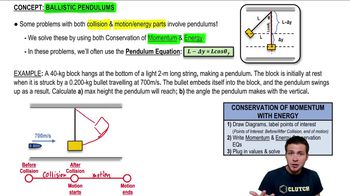
First, use conservation of momentum to find the velocity of the combined block and bullet immediately after the collision: (m_bullet * v_bullet_initial + m_block * v_block_initial) = (m_bullet + m_block) * V_B. Then, apply conservation of energy as the block-bullet system swings upward: (1/2)(m_bullet + m_block)V_B^2 = (m_bullet + m_block)gY_C. Solving for the maximum height Y_C gives Y_C = V_B^2 / (2g).
What are the three key points labeled in a ballistic pendulum problem and what do they represent?
The three points are A (before collision), B (after collision), and C (maximum height). Point A is when the bullet is moving toward the block, B is immediately after the collision, and C is when the pendulum reaches its highest point.
Why is the lowest point of the pendulum's swing set to y = 0 in the energy analysis?
Setting y = 0 at the lowest point simplifies the calculation by making the gravitational potential energy zero there. This allows all height changes to be measured relative to this point.
What type of collision occurs in a ballistic pendulum when the bullet embeds itself in the block?
The collision is completely inelastic because the bullet and block stick together after impact. This means they move as a single combined mass after the collision.
How do you calculate the velocity of the block-bullet system immediately after the collision?
Use conservation of momentum: set the total initial momentum of the bullet and block equal to the combined mass times their shared velocity after the collision. Solve for the final velocity using the given masses and initial velocities.
What is the significance of the angle θ_Y in the ballistic pendulum problem?
θ_Y is the angle the pendulum makes with the vertical at its maximum height. It is found using the relationship between the pendulum's length, the height it rises, and trigonometric functions.
Which trigonometric function is used to relate the pendulum's length, height, and angle at maximum swing?
The cosine function is used, specifically in the equation l - y_c = l cos(θ_Y). This allows solving for θ_Y using the inverse cosine.
Why is there no kinetic energy at the pendulum's maximum height?
At maximum height, the block-bullet system momentarily stops before swinging back down, so its velocity is zero. Therefore, all the energy is gravitational potential energy.
What assumption is made about non-conservative forces in the ballistic pendulum analysis?
It is assumed that there is no work done by non-conservative forces such as friction or air resistance. This allows the use of conservation of mechanical energy from point B to C.
How is the final answer for the maximum height reached by the block-bullet system numerically calculated in the example?
First, the velocity after collision is found to be 3.48 m/s, then this value is squared and divided by twice the acceleration due to gravity (2 × 9.8 m/s²). The resulting height is 0.62 meters.