Control buttons has been changed to "navigation" mode.
1/10
Terms in this set (10)
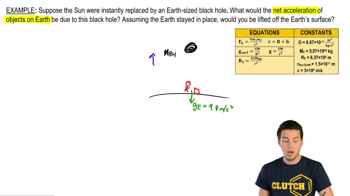
What would happen to Earth's orbit if the Sun suddenly became a black hole without changing its mass?
If the Sun became a black hole without changing its mass, Earth's orbit would remain unchanged. The gravitational pull at Earth's distance would be the same, so Earth would continue orbiting as before.
Which type of astronomical system is most likely to contain a black hole?
A system containing a very massive, compact object that does not emit light and has a strong gravitational influence on nearby objects is most likely to contain a black hole.
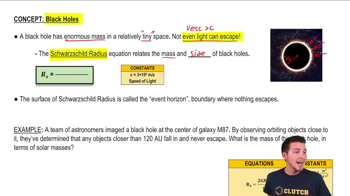
What is the event horizon of a black hole?
The event horizon is the boundary around a black hole beyond which nothing, not even light, can escape. It marks the Schwarzschild radius, where the escape velocity equals the speed of light.
A black hole is likely to be the end stage of stellar evolution for what type of main-sequence star?
A black hole is likely to be the end stage for a very massive main-sequence star, much more massive than the Sun.
What process occurs before a black hole comes into existence?
Before a black hole forms, a massive star undergoes gravitational collapse at the end of its life, concentrating its mass into a very small volume.
What evidence suggests that the star system Cygnus X-1 contains a black hole?
Cygnus X-1 is believed to contain a black hole because it has a very massive, compact object that does not emit light but exerts strong gravitational effects on nearby matter.
What is the singularity of a black hole?
The singularity of a black hole is the point at its center where mass is concentrated into an infinitely small volume and density becomes infinite.
How do you calculate the event horizon (Schwarzschild radius) for a black hole with 10 times the mass of the Sun?
The event horizon (Schwarzschild radius) is calculated using the formula: Rs = 2GM/c^2, where G is the gravitational constant, M is the mass (10 times the mass of the Sun), and c is the speed of light.
Why does a black hole appear black to observers on the outside?
A black hole appears black because no light can escape from within its event horizon to reach observers. This is due to the escape velocity exceeding the speed of light, which nothing can surpass.
What unit conversion must be performed when calculating the mass of a black hole using the Schwarzschild radius in astronomical units (AU)?
The Schwarzschild radius given in AU must be converted to meters using the conversion factor 1 AU = 1.5 × 10^11 meters. This ensures all quantities are in SI units for the calculation.